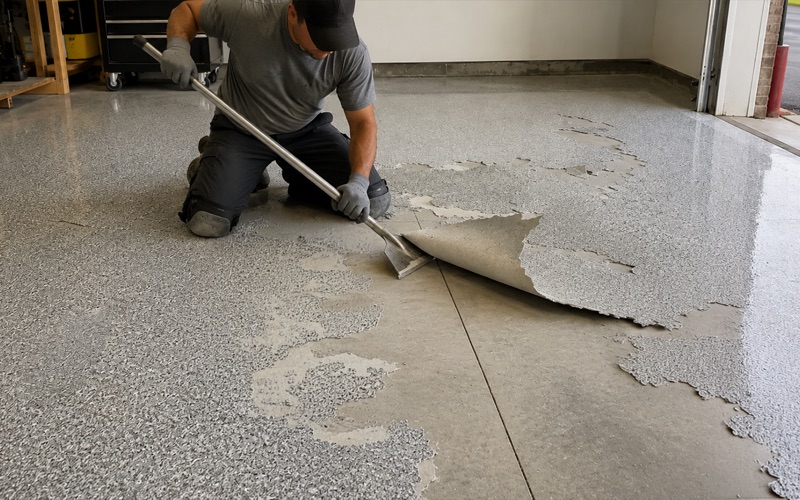
College Station Epoxy Flooring installs epoxy flooring in Waller, where two things are true about the ground that rarely go together. It holds water through the winter, and it does not move.
Close to half the city sits on a soil carrying a saturated zone from roughly six to twenty-four inches down through November, December, January and February. At the same time the city holds none of the soil orders associated with seasonal ground movement, and more than three quarters of it is low-movement ground throughout.
That combination decides how a floor here is specified. Movement is not the design case. Moisture is, and it is present on a predictable seasonal schedule rather than as an occasional event. A predictable problem is a solvable one, which is genuinely better news than it sounds.
Ground That Holds Water From November Through February
A Saturated Zone on a Calendar
The dominant soil here carries its saturated zone across four named winter months. That is a published property of the material, which means the wet period is predictable rather than something that happens in unusually wet years.
A zone of that kind sits directly beneath a typical slab and acts as a reservoir under the concrete for a third of the year. Vapor moves upward from it through the slab regardless of how stable the ground itself is.
Predictability is genuinely useful when specifying. A seasonal condition that arrives on schedule can be designed for, unlike a variable one that may or may not appear. We would rather design for a condition we know arrives every winter than hedge against an uncertain one.
Stable Ground, Wet Profile
The absence of movement-prone soil orders here means the usual cracking cycle driven by clay swelling and drying is not the local mechanism. A slab in this town is far less likely to be responding to seasonal ground behavior than one twenty miles north.
That does not make the ground benign. Water under a slab is its own problem and it attacks the bond between coating and concrete rather than the concrete itself.
So the specification effort goes into vapor management rather than joint strategy, which is a meaningfully different quote from the one we would write in a movement-prone town. Two quotes written for the same building in different towns should not look the same, and here they genuinely do not.
Testing Against the Wet Season
Moisture testing is in the scope on any slab we did not pour. Calcium chloride testing and in-situ relative humidity probes give the figures a product’s thresholds are written against, and the probes are the more informative here because they read inside the slab rather than at its face.
Timing matters more in this town than in most. A reading taken in high summer on ground that saturates from November describes a condition that will not hold through the year, so we interpret readings against the season rather than treating them as fixed. Asking when a slab was last wet is frequently more useful than the number on the meter that day.
Where the figures call for a moisture-mitigation primer, it goes into the proposal rather than appearing later as a change order. Specifying for the wet months rather than the dry ones is the whole point. A floor specified for August on ground that saturates in January has been specified for the easy half of the year.
Looking for epoxy flooring closer to Magnolia? See Magnolia Epoxy Flooring.
Who the Building Official Actually Is in Waller
A Private Firm, Named in the City’s Own Paperwork
The city’s contractor registration paperwork states plainly that a private firm serves as both its building official and its fire marshal, and that the firm sets the timing, process and procedures used to enforce the city’s ordinances.
That is an unusual arrangement to see stated so directly, and it is worth knowing before starting any permitted work. The people reviewing and inspecting are not city employees and they run their own process. It is stated in the city’s own paperwork rather than being something we inferred, which is why we are comfortable naming it. The same notice reserves the right to refuse review and inspection for habitual noncompliance, false call-outs or turning up unprepared, which tells you something about how the arrangement is run in practice.
What That Means for Scheduling
Where a floor is part of a permitted project, the inspection calendar belongs to that firm rather than to a city department. Planning a shutdown around it means confirming availability rather than assuming a municipal timetable.
For an interior floor coating on its own it changes nothing, because finish work of that kind is exempt from permitting. It matters where flooring rides on a commercial finish-out permit.
We establish which of those applies at the quoting stage by asking what else is happening in the space, rather than discovering it once the work has started. One question at the quoting stage resolves it, and it costs nobody anything to ask.
Permits Expire and Early Starts Cost Double
Two specifics in this city’s regime are worth knowing. Permits expire after a fixed period rather than running indefinitely, and work begun before a permit issues attracts a doubled fee.
Neither applies to a standalone floor coating, but both matter on a wider project where a floor is one trade among several. A permit that lapses mid-project is a scheduling problem that lands on whoever is on site when it happens.
Mentioning it in advance is part of what a proposal is for. It costs a sentence and it occasionally saves somebody a substantial and entirely avoidable charge. Small procedural details like this are exactly what an out-of-area contractor tends to miss.
A Small Owner-Occupied Base in a Renter Majority Town
The Shape of the Local Market
Around two thirds of households here rent rather than own, only a minority of the housing stock is detached, and about a fifth is manufactured housing. The owner-occupied detached total sits in the low hundreds. That is a small conventional garage market in absolute terms, and it means a large share of the residential concrete here is exterior or semi-exterior rather than an enclosed attached garage.
It also means rental and small commercial property makes up more of the local work than the population alone would suggest, and those jobs are specified differently. Understanding that mix matters before assuming what kind of work a town this size generates.
Manufactured Homes and Outdoor Slabs
A manufactured home typically presents a pad, a carport slab or a patio. Those surfaces take direct sunlight, rain and thermal cycling, which rules out an interior-grade epoxy topcoat and calls for an ultraviolet-stable polyaspartic or polyurea finish.
Drainage matters as much as the coating. A pad is built to shed water away from the home, and a coating must not interfere with that fall or create a low spot that holds water against the structure.
On ground that already carries a seasonal saturated zone, keeping surface water moving away from a building matters more than any product decision we could make. Where a pad already holds water we price the drainage correction separately rather than coating over it.
Rental Turnovers and What They Need
Rental work runs against a handover date rather than a contractor’s convenience, and durability usually outranks appearance. A floor that survives several tenancies without attention is worth more than one that photographs well on the first day.
Where a window is genuinely tight, fast-cure systems exist for that constraint and are the honest answer rather than an upsell. We ask for the handover date before quoting because it can change the system entirely.
That is a different conversation from a homeowner’s, and treating the two the same way is how a rental floor ends up specified for the wrong priorities. Appearance still matters on a rental floor; it simply does not outrank getting the unit back on time.
Getting the Work Right on This Ground
Preparation Does Not Change
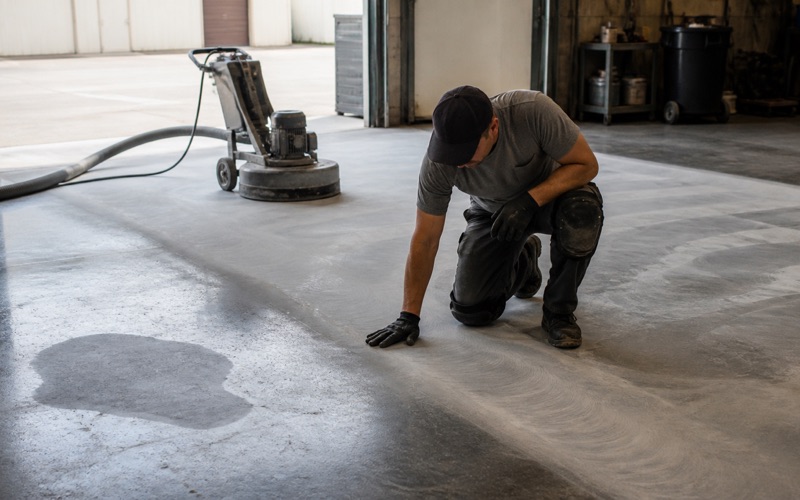
Every slab is opened mechanically to a measured surface profile, by diamond grinding or shot blasting depending on the floor. We do not acid etch, and we do not coat over an existing sealer.
That standard is constant regardless of soil, city or property type. Preparation remains the single largest predictor of whether a floor is still bonded in five years, and no ground condition makes it less important.
What varies is what we expect to find and what we test for, which is the part of the assessment that actually changes from town to town. The standard is fixed and the diagnosis is local, which is the right way round.
Cracks and Joints Where Ground Is Stable
On stable ground, cracks in a slab are more often construction-era or load-related than seasonal, which changes how they are treated. A settled crack can be filled rigid and disappears under the finish.
We still assess each one rather than assuming, because a stable soil profile does not guarantee a stable slab. Poor compaction, a plumbing leak or a tree can all produce movement that has nothing to do with the surrounding soil.
Where a crack is still working it is treated as a joint with a semi-rigid filler, and we say in advance that it may show again, whatever the soil map says about the neighborhood. A soil map describes the ground, not the slab, and the slab is what we are bonding to.
What Goes in the Proposal
The proposal names the product, the system build and the mil thickness, along with the moisture readings and both return-to-service dates. That level of specificity lets the finished floor be checked against what was sold.
Texas issues no state license for flooring, coatings or painting work, so instead of a license number we show liability cover, workers compensation and a Texas sales and use tax permit, all of which can be verified.
Where we think a coating is the wrong answer for a particular slab, the proposal says that instead. On ground that stays wet for a third of the year, that judgement comes up more often than it does elsewhere.
- 20+ Years in the Brazos Valley
- Insured & Registered
- Free Written Proposals