College Station Epoxy Flooring installs epoxy flooring in Rockdale, a town that is genuinely divided between two kinds of ground. Not divided by neighborhood in a way you could draw on a map, but divided by soil, and the split is close to two thirds against a quarter.
Roughly two thirds of the town has reactive material lying beneath a non-reactive cap. Rather more than a quarter is low-movement ground all the way through and will not move at all. There are no soils here associated with material sitting reactive right at the surface.
Which of those two a slab sits on determines what the floor has to be designed for, and it is not something anybody can tell from an address. Two houses on the same street can sit on different sides of that split, which is why we look rather than assume.
Two Different Grounds Inside One Town
The Split, With Numbers
Three series between them cover about two thirds of the town, and all three share the same structure: an inert layer on top with reactive material underneath. Two further series cover rather more than a quarter and are low-movement throughout their profile.
That is an unusually clean division. Most towns present a gradient; this one presents two distinct populations of site with relatively little in between. That makes the assessment unusually decisive here, since the answer tends to be clearly one or the other.
The practical consequence is that a specification suited to one is over-engineered for the other, and quoting both the same way means somebody is paying for work their slab does not need. It also means a competing quote that ignores the distinction is quoting an average rather than a building.
What a Cap Changes
Where reactive material lies beneath a non-reactive layer, seasonal moisture change reaches it slowly and indirectly rather than acting on it straight from the weather. The cap buffers the cycle that would otherwise drive movement.
That is better than reactive material lying directly under a slab, but it is not the same as inert ground. The material is still present and still responds to a wet winter followed by a dry summer. The buffer moderates the cycle rather than removing it, and how much it moderates depends on how thick it is.
Cracking in that arrangement begins at the top of the reactive horizon and works downward rather than opening at ground level, which is why the absence of visible surface cracking proves very little on its own. A clean-looking slab on capped reactive ground is a normal sight rather than a guarantee.
Why Grading Matters Here
The published descriptions for this kind of ground carry a clause worth knowing: where the surface layer is eroded or thin, the material cracks all the way up. Site grading does exactly that on purpose. A lot cut and scraped before the slab was poured may have lost most of its buffer, which means the general soil picture describes conditions that no longer apply to that property.
So we ask about site history and read the existing slab for evidence, because on divided ground like this the exceptions are usually man-made rather than natural. Long-term owners usually remember what was done to the lot; recent buyers frequently do not.
Looking for epoxy flooring closer to Bellville? See Epoxy Flooring Services in Bellville.
What the County Started Requiring in 2025
A New Fire Code Regime
The county adopted a fire code that took effect in 2025 and reaches commercial establishments, public buildings and multi-family residences in unincorporated areas. It carries a permit requirement, a fee structure and an annual inspection, and the permit includes a certificate of compliance. That is a genuine change rather than a formality, and it means any research or advice predating 2025 about permitting in the unincorporated county is now out of date.
For work inside the city limits the city’s own regime applies, and property in the city’s extraterritorial area can carry the city’s fire code in addition to the county’s. Establishing which regime applies takes one call and removes a class of expensive surprise.
Where a Floor Coating Sits
Interior floor coating is finish work. The county’s own tenant finish-out provisions confirm that a coating-only job does not trigger the permitting regime on its own, and finish work of that kind is exempt wherever a building code has been adopted.
Where a floor forms part of a wider commercial finish-out, it rides on that project’s permit rather than standing alone. That is the distinction worth establishing before a job rather than during it. Most floor jobs here are unambiguously exempt, and saying so plainly is more useful than implying complexity. We ask what else is happening in a space rather than only what is happening to the floor, which is normally enough to settle which situation applies.
Contractor Registration in the City
The city requires contractors to register annually with a fee, and it asks for more than a form: a professional license copy where applicable, a license and permit bond, and liability insurance naming the city as additional insured.
The bond requirement scales with the value of the work, which is a more structured approach than most towns of this size take. Work carried out without a permit attracts a doubled fee.
None of that applies to a standalone floor coating, but it applies to the wider projects a floor is sometimes part of, and it is worth knowing before scheduling anything. A bond requirement that scales with job value is unusual enough that out-of-area contractors regularly miss it.
Rental Houses and What Holds Up in Them
An Unusual Share of Rented Detached Housing
Close to thirty percent of the detached houses in this town are renter-occupied, which is a considerably higher proportion than most towns of this size carry. That is several hundred individual houses being let rather than lived in by their owners.
For a flooring contractor that is a distinct market with different priorities. Turnover work runs against a handover date, and durability and speed of return matter more than the finish photographing well.
It also means a higher share of the garages here see multiple occupants over a decade, with the wear pattern that implies. Garages in let properties tend to see harder use and less maintenance than owner-occupied ones.
Specifying for Turnover
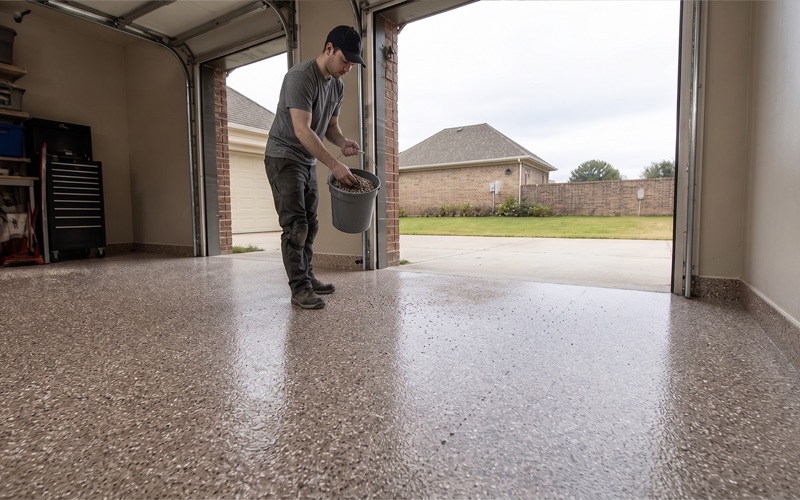
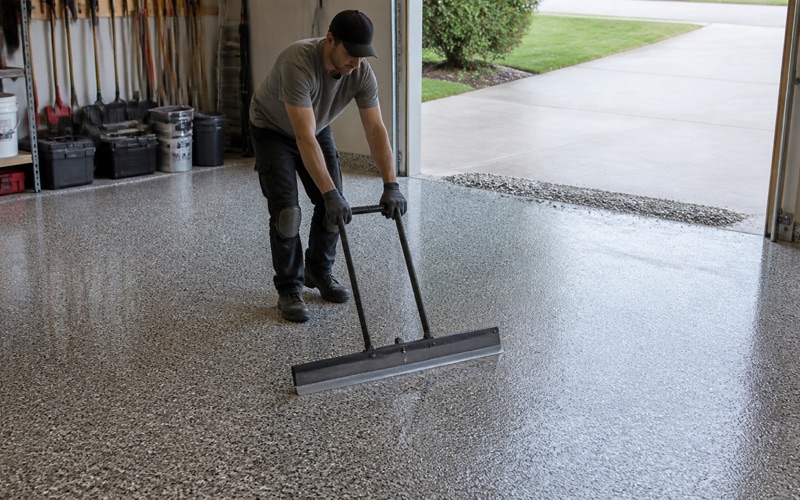
Where a floor will be handed over repeatedly, a full flake broadcast is usually the honest recommendation. It hides slab imperfection, hides wear, adds grip and takes an almost invisible repair, all of which matter more on a let property than on an owner’s own garage.
Where the handover window is genuinely tight, fast-cure systems exist for that constraint rather than as an upsell. We ask for the date before quoting because it can change the system entirely. Specifying a rental floor as though it were an owner-occupier’s is how the wrong priorities end up being paid for.
An Older, Two-Era Housing Stock
The housing here divides almost evenly between two decades, the nineteen fifties and the nineteen seventies, which together make up half the stock, with a trough between them and effectively nothing built in recent years. That means most slabs here predate current practice on under-slab vapor retarders, and many carry a previous coating, a sealer, or a repair made decades ago.
None of that is a problem in itself. All of it is something to find before quoting rather than after starting, which is why the assessment visit matters more on stock of this age. A slab poured in the fifties and a slab poured in the seventies are different propositions, and both are common here.
Industrial Floors and Heavy Plant
What Industrial Work Here Looks Like
The town carries substantial industrial development, including large-scale data center operations with significant developed capacity across multiple buildings on one site. That is a different class of floor from a workshop bay.
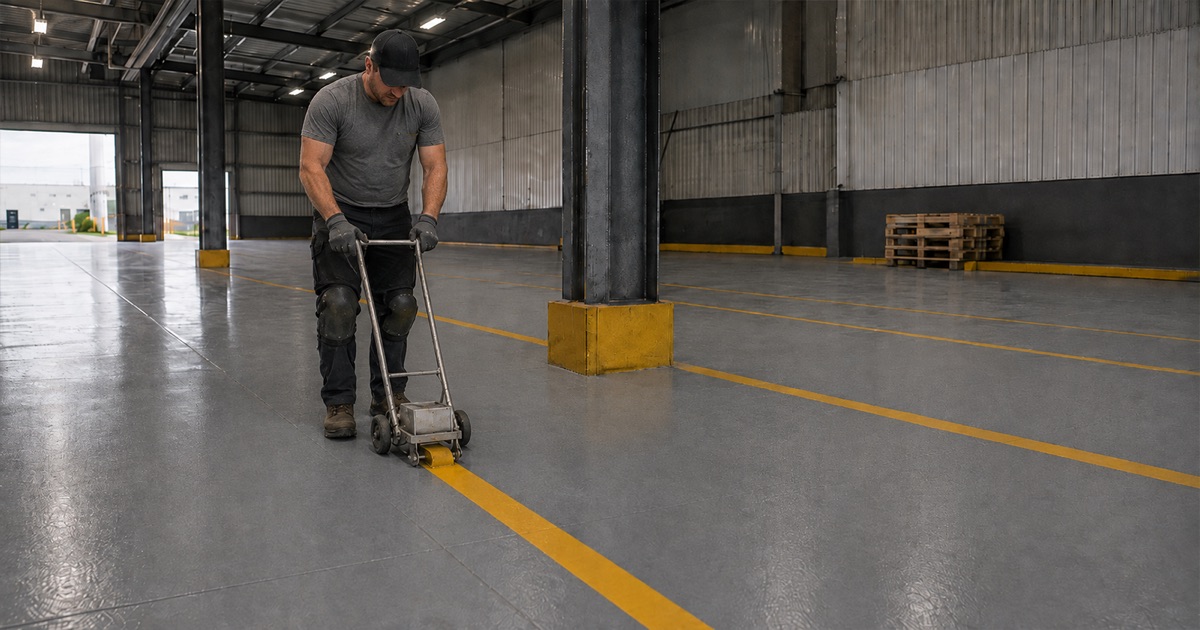
Industrial floors live or die on joint treatment rather than on coating selection. A semi-rigid filler supports joint edges under hard wheel loads, and that single decision does more for a large floor’s service life than anything else. Getting joint treatment right is worth more over a decade than any upgrade to the coating itself. Line marking, traffic zoning and safety demarcation are laid into the system rather than painted on top, so they wear at the same rate as the floor around them.
Chemical and Thermal Exposure
Plant environments bring exposures a garage never sees, including fuel, solvents, thermal cycling and in some cases battery or fluid containment requirements. Each pushes the specification toward a different system.
Urethane cement handles heat and aggressive chemistry far better than a standard epoxy build, and it is the correct answer where those conditions genuinely exist rather than a default upgrade. Specifying it where it is not needed is an easy way to double a price without improving a floor. We specify by area rather than applying one build across an entire facility, because coating a whole building to the standard of its worst corner wastes money without buying anything.
Working Around Operations
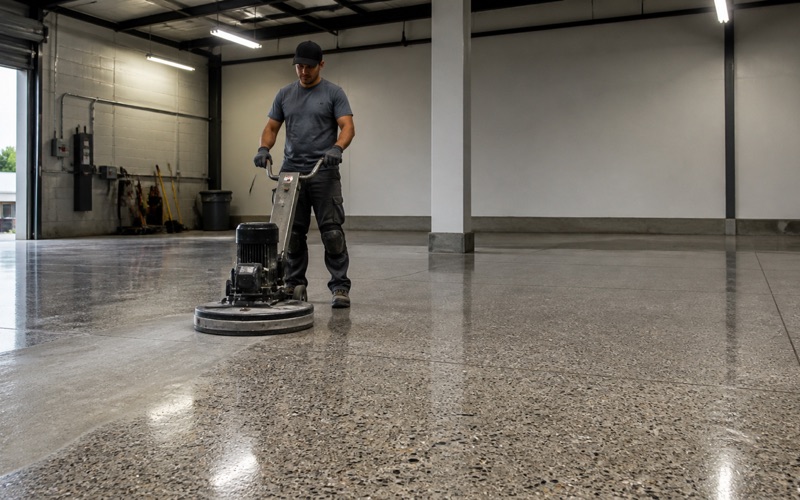
Industrial floors usually belong to facilities that cannot stop. Work is sequenced in bays with the day’s stopping point planned rather than improvised, and where downtime binds, the system is chosen for cure speed rather than cost per square foot. Containment matters more in an operating facility than anywhere else, since grinding dust travels considerably further than people expect and neighboring equipment has to be protected.
We agree access, hours and containment before the first machine runs rather than negotiating them once somebody complains. Night and weekend working is normal on this kind of job rather than exceptional.
- 20+ Years in the Brazos Valley
- Insured & Registered
- Free Written Proposals