College Station Epoxy Flooring installs epoxy flooring in Prairie View, a town where the ground presents a completely different problem from most of the area we cover. Nothing here moves much. What it does instead is hold water.
None of the town carries material that swells and shrinks at the surface, and close to ninety percent is low-movement ground throughout its profile. What the dominant soil does carry is a saturated zone that sits within the top few feet through winter and spring, for weeks at a time.
That reverses the usual conversation. The question is not what the ground will do to a slab but what moisture in the profile will do to a coating bonded to one, and those need different answers.
Water in the Profile Through Winter and Spring
A Saturated Zone, Not a Movement Problem
The dominant soil across this town is saturated from roughly four inches down to nearly three feet, for periods of three to six weeks during winter and spring. That is a published characteristic of the material rather than an observation from a wet year.
A saturated zone at that depth sits directly beneath a typical slab. It is a reservoir of moisture under the concrete for a meaningful part of every year, and it drives vapor upward through the slab regardless of how still the ground itself is.
So the risk here is a coating losing its bond from underneath rather than a slab cracking from movement. Those failures look different, they happen on different timescales, and they call for different work. Recognizing which of the two a site presents is the first decision on any job here, and it is not a close call in this town.
Why Moisture Testing Carries the Specification
On ground like this, moisture testing is not a formality. Calcium chloride testing and in-situ relative humidity probes produce the figures a product’s own thresholds are written against, and those figures decide whether a moisture-mitigation primer belongs in the system.
The probes are the more informative of the two here because they read humidity inside the slab at depth rather than at its surface. That is the measurement that predicts what a coating will face across the year rather than on the day of the test.
Testing in a dry September on ground that saturates in February is exactly how a floor gets specified for the wrong season, which is why we read the profile rather than only the moment. A single reading taken at the wrong time of year can be genuinely misleading on ground with this profile.
What a Wet Profile Does to a Coating
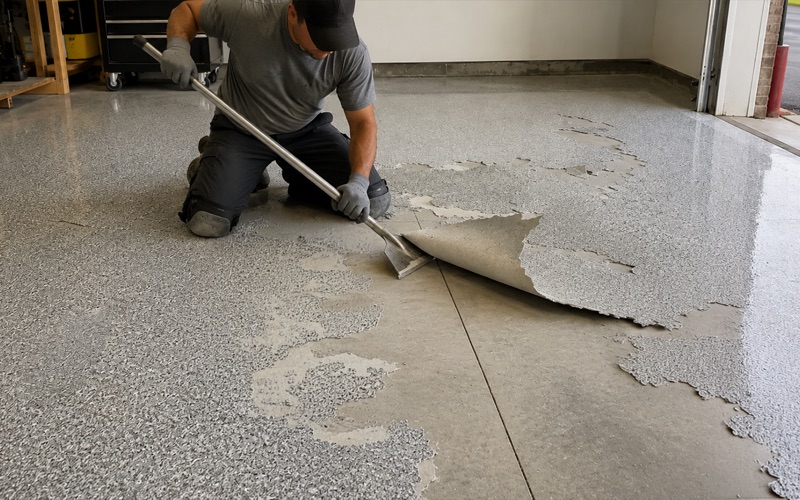
Where vapor pressure from below exceeds what a coating can resist, the result is blistering, pinholing or a floor that lifts in sheets. It is the single most common failure mode we are called out to look at, and it is entirely preventable.
Prevention means either a system rated for the vapor drive that is actually present, or a mitigation primer beneath it. Both cost money and both are cheaper than doing the floor twice.
Where the numbers say a mitigation layer is required, it appears in the proposal rather than arriving as a change order once work has started. That is the point of testing before quoting rather than after. Nobody enjoys a change order and this particular one is entirely predictable from the ground records.
Looking for epoxy flooring closer to Waller? See Epoxy Flooring Services in Waller.
A Campus Town and the Floors That Serve It
Half the Population Lives in Group Quarters
Just over half of this town’s population lives in group quarters rather than in conventional households, which is a profile almost no other community in this area shares. Only a minority of residents live in ordinary housing units.
The practical consequence is that the private garage market here is the smallest of anywhere we work. Owner-occupied detached houses number in the low hundreds, and they represent a small share of households.
So the work here skews institutional and commercial rather than residential, and the specifications that matter are the ones written for buildings serving large numbers of people rather than for a family garage. That shapes what we carry, how we schedule and which questions we ask first on an enquiry from this town.
What Institutional Floors Have to Do
Floors serving large populations face concentrated traffic on defined routes, frequent cleaning with aggressive chemistry, and long periods where a building cannot be disturbed. Each of those pushes the specification in a particular direction.
Cleaning regime usually matters more than traffic volume. A floor washed daily with strong chemistry needs chemical resistance and a seamless detail at every junction, because contamination collects wherever a surface stops.
Coved bases, sealed penetrations and properly detailed thresholds are most of the labor on that kind of work. They are also the first things cut from a cheap quote, and the first things to fail. A quote that does not itemize coving and penetration detailing is usually a quote that has left them out.
Kitchens and Food Service
Food preparation areas answer to the Food Code that Texas adopts by reference, and its floor language is specific: the surface has to be smooth, durable and easily cleanable, and nonabsorbent anywhere it gets wet, with the wall junction coved and closed to a tolerance measured in fractions of an inch.
The apparent conflict between a smooth floor and a slip-resistant one is answered by the code itself, which explicitly permits antislip applications used for safety reasons. That carve-out allows a floor that is genuinely safe underfoot and still compliant.
Urethane cement is usually the right specification in a working kitchen because it tolerates heat, steam and washdown far better than a standard epoxy build does. It is the correct answer rather than an upgrade. We will say when a service area genuinely does not need it, because a dry store room is a different specification from a cook line.
Working as a Subcontractor on System Projects
How Larger Projects Are Actually Let
Substantial construction and renovation projects at institutions of this kind are generally let to a prime contractor, who then subcontracts the trades. A flooring specialist reaches that work as a subcontractor rather than by bidding directly.
State rules also set participation goals for historically underutilized businesses, with the highest goal of all applying to special trade construction contracts, and require a subcontracting plan on larger solicitations. Those mechanisms exist specifically to route work to specialist subcontractors.
That is the realistic route onto a project of any size here, and it is worth being straightforward about rather than implying a relationship that does not exist. Overstating a relationship is easy to do and easy to check, which is why we describe ours precisely.
What We Do and Do Not Claim
We are a flooring contractor. We are not a prime contractor on institutional capital work and we do not describe ourselves as anybody’s approved vendor unless that is a documented fact.
What we offer is the trade capability: surface preparation, resinous and cementitious systems, coved detailing and the scheduling discipline that a fixed-calendar project requires. Those are the things a prime contractor is actually looking for.
Being precise about that distinction matters more than it might seem. A contractor who overstates their position on one project has told you how they will describe the next one. Precision about your own position is one of the few things a client can actually verify before hiring anybody.
Scheduling Against a Fixed Calendar
Institutional work happens in the windows when a building is empty, and those windows do not move. The handover date is effectively part of the specification rather than a target. We build the program backwards from the reopening date rather than forwards from a start date, and where the window is genuinely tight, fast-cure systems exist for exactly that constraint.
That also means the assessment has to happen well in advance. Discovering a moisture problem a week before a shutdown is a far worse position than discovering it several months out. Assessments booked well ahead cost nothing extra and remove most of the risk from a fixed-date program.
The Soil Series Described on This Campus
A Type Location on the Grounds
One soil series in this area has its official type location described on the university campus itself, which is a genuine piece of local specificity rather than a marketing line. Soil scientists describe a series from a representative site, and this one is here.
It is a small fact with a real implication: the ground under this town is characterized well enough to be a reference point, and the published descriptions apply directly rather than by extension from somewhere nearby.
That is useful when specifying, because it means the moisture behavior recorded in those descriptions is describing this place rather than a general regional pattern. Local specificity of that kind is rare and worth using where it exists.
What the Descriptions Tell Us
The published records for the dominant soils here consistently describe low movement and seasonal saturation rather than the reverse. That combination is the defining local condition and it is unusually consistent across the town.
It gives a clear specification logic. Ground movement is not the design case; vapor drive is, and the system is chosen and primed accordingly.
Knowing that from published records rather than from a guess is what allows a proposal to explain its own reasoning rather than simply asserting a product choice. A proposal that shows its reasoning is easier to compare against a competing one on substance.
Reading the Slab Anyway
Published soil information tells us what to expect. It does not tell us what a particular slab is doing, which depends on its age, whether anything was laid beneath it when it was poured, and what has happened to it since.
So every quote follows a visit, and every slab we did not pour gets tested. The readings describe the concrete in front of us, and the specification is built on those rather than on the map.
On ground with a seasonal saturated zone, that measurement is not a formality. It is the entire basis on which the floor is designed. Skipping it on this ground would be the single most expensive shortcut available on the job.
- 20+ Years in the Brazos Valley
- Insured & Registered
- Free Written Proposals