
College Station Epoxy Flooring resurfaces and coats pool decks across College Station, Texas and the surrounding cities of Bryan, Lake Bryan, Navasota, Caldwell and Hearne, with more than 20 years of concrete and resinous flooring behind the work. A pool deck is the most demanding exterior slab we handle, because it has to satisfy three requirements that pull against each other.
It has to be slip resistant while wet, since that is its normal condition and bare feet are the normal traffic. It has to stay tolerable to stand on through a Texas summer afternoon. And it has to survive chlorinated or salt water, sunscreen, and the constant wet-dry cycling at the coping edge.
Almost every failed pool deck we are asked to look at was specified for one of those three and not the other two. A smooth finish that looks superb dry, a dark color that becomes unusable in July, or an interior-grade system that chalks out within a season.
The Three Constraints
Slip Resistance When Wet
A pool deck is wet in normal use, so grip has to come from surface texture rather than from a coating’s inherent properties. Knockdown textures, broadcast aggregate and slip-resistant additives all achieve it to different degrees, and the right level depends on whether the deck sees mostly adults walking or children running. Too little texture is a hazard and too much is uncomfortable barefoot, so this is a calibrated decision rather than a switch. We set it against the actual users, since a deck used by young children wants more grip than one used by adults who mostly sit.
Surface Temperature Underfoot
Color and finish drive how hot a deck gets, and in this market that is not a minor comfort question. A dark deck in direct sun through a Central Texas afternoon becomes genuinely unusable barefoot. Lighter colors and cool-deck style textured overlays reflect substantially more, and specifying a dark color on an unshaded deck is the single most common regret we hear about. Shade structures change the calculation, so we ask about them before recommending a palette rather than after.
Pool Chemistry and Constant Wetting
Chlorine, salt systems, sunscreen and pool chemicals all attack a coating, and the coping edge takes continuous wet-dry cycling that the middle of the deck does not. Materials are chosen for that exposure specifically, and the detail where the deck meets the coping and the waterline is where a poorly specified system fails first. Salt systems in particular are harder on a coating than many owners expect, and they are increasingly common in this market.
Systems We Use on Pool Decks
Textured Cementitious Overlays
A polymer-modified overlay applied with a knockdown or spray texture is the classic cool-deck approach, and it remains one of the best answers here. It restores a worn or ugly deck, delivers texture as an inherent property rather than as an additive, and takes integral color. It also bonds to a sound existing slab without demolition. It is also the most forgiving option on a deck whose surface is tired but whose structure is fine.
Resinous Systems With Broadcast Aggregate
Where a client wants a resinous finish, a system with quartz or a fine aggregate broadcast under an ultraviolet-stable topcoat gives durability with genuine wet grip. This suits decks that see heavy use or that need chemical resistance, and it holds color far better than a cementitious overlay through years of direct sun. The trade-off is cost and a slightly different feel underfoot, which is worth comparing on a sample before deciding.
Repair and Recoat of an Existing Deck
Many pool decks need repair rather than replacement, with spalled edges, cracks and a tired surface over structurally sound concrete. Rebuilding the damaged areas and resurfacing the whole deck gives a uniform result for considerably less than a tear-out. We assess whether that is realistic before proposing it, since resurfacing over a failing slab postpones the problem rather than solving it. We would rather quote the repair honestly than resurface a deck that will move again next summer.
Preparation and Detailing
Mechanical Preparation, Not Washing
A pool deck carries years of sunscreen, body oils, pool chemicals and frequently a sealer, none of which pressure washing removes. The slab is ground or shot blasted to a measured profile like any other, and this matters more here than on a driveway because the contamination is more penetrating and the consequences of a bond failure are underfoot. Sunscreen in particular soaks into concrete over years and is invisible until a coating refuses to bond to it.
Coping, Waterline and Expansion Joints
The junction between deck and coping is the hardest working detail on the whole slab and the place a cheap job shows first. Expansion joints around a pool are there because the deck and the pool structure move independently, and they are honored rather than coated across. Filling a pool expansion joint solid is a guaranteed crack. Every joint around the pool is mapped before quoting so none of them is discovered mid-pour.
Drainage and Standing Water
A deck is built to shed water toward drains or away from the pool, and a resurfacing job reproduces the existing fall unless it is deliberately corrected. Where a deck ponds, we say so and price the correction rather than laying a new surface that holds water in exactly the same place it always has. Correcting fall on a pool deck is a genuine option and it is a different scope, so it is priced separately rather than assumed.
Living With the Finished Deck
Cleaning and Maintenance
A textured deck needs a different cleaning routine from a smooth one, since texture holds soil as well as it holds feet. We hand over the maintenance regime in writing, including which cleaners to avoid, because aggressive chemistry will dull a coated deck faster than sunlight or traffic ever will. Most premature dulling on a pool deck traces back to cleaning products rather than to the sun.
Reasonable Expectations on Longevity
An exterior slab in constant sun, constant water and regular chemical contact is a hard service environment, and no coating lasts forever there. What a good specification buys is years rather than seasons, and a deck that can be recoated rather than removed when it eventually tires. Buying a system that can be recoated in place is worth more over a decade than buying the hardest possible surface once.
Scheduling Around Pool Use
Pool decks are seasonal work in practice, and the deck has to stay out of use through cure. We plan the sequence so the pool itself stays protected and give both the foot-traffic and the full-service dates at handover, since a deck walked on early marks permanently. Furniture placement after cure matters too, since point loads on a fresh surface leave impressions that do not lift.
Choosing a Finish for a Barefoot Surface
Knockdown, Broom and Broadcast Textures
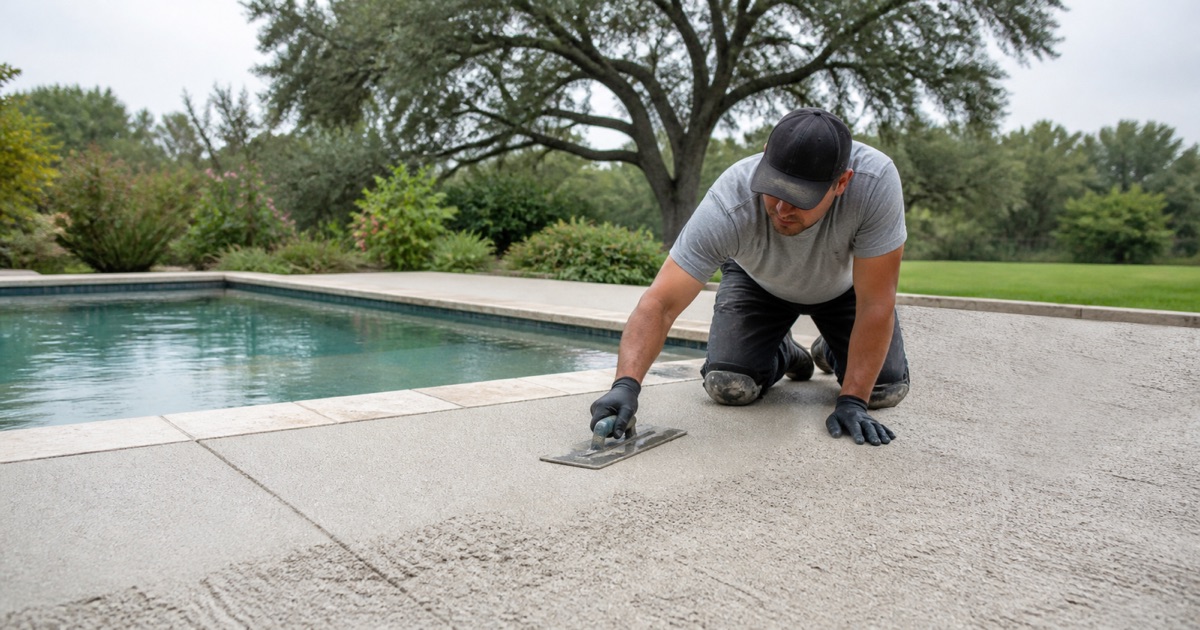
A knockdown texture is troweled and then flattened to leave a rounded, comfortable profile that grips without abrading feet. A broom finish is coarser and cheaper and can be harsh barefoot. A broadcast aggregate under a clear topcoat sits between the two and lasts longest. Each feels distinctly different, which is why we put samples down and have people stand on them wet rather than choosing from a brochure.
Color, Pattern and Borders
Integral color, banding and a contrasting border around the coping give a deck definition and disguise the transitions where the surface meets the pool, the house and the surrounding hardscape. Pattern also breaks up a large expanse of one color, which matters visually on a big deck and helps hide the wear that concentrates along the walking routes people actually use.
Matching the Deck to the Surrounding Hardscape
A pool deck rarely exists alone. It meets patios, walkways, steps and sometimes a driveway, and treating those as one visual scheme produces a far better result than resurfacing the deck in isolation. Where the adjoining surfaces are staying, we choose color and texture to sit with them rather than against them.
- 20+ Years in the Brazos Valley
- Insured & Registered
- Free Written Proposals