College Station Epoxy Flooring installs epoxy flooring in Pinehurst, an unincorporated community where the most important fact for a property owner is written down in a signed county letter rather than inferred from anything.
That letter states that building codes are not enforced for single family residential structures or for multi-family buildings under four units, that the county has no zoning regulations, and that no codes were enforced at all before January 2008.
For anybody buying a floor, that changes what can be relied upon. It also happens to sit on ground that is about as stable as anything in this region, for a reason that comes down to clay chemistry rather than luck. Those two facts together make this an unusually straightforward place to specify a floor, once you know them.
What Was and Was Not Enforced Out Here
A Documented Absence, Not an Assumption
Most of the time, establishing what rules apply in an unincorporated area means piecing together what nobody has written down. Here the county has stated it plainly and in writing, which is unusual and genuinely useful.
Single family homes are outside code enforcement. The county issues no certificates of occupancy and operates no zoning. And there is a hard date before which nothing was enforced at all.
That last point matters more than the others, because it divides the local housing stock into two categories with very different histories behind them. It is also a date worth knowing when buying a property here rather than only when coating one.
What the Date Means for an Older House
A house built here before 2008 was constructed without code enforcement behind it. That is not an accusation about any particular builder, and plenty of those houses were built perfectly well by people who knew their trade.
It does mean there is no inspection record, no plan review and no certificate to consult. Whatever was or was not done beneath a slab, nobody official verified it and nothing documents it.
So we test rather than assume on any older property here. What is under the concrete is genuinely unknown, and the readings we take are the only reliable information available about it. That is not a criticism of the local housing, it is simply a description of what evidence exists.
Commercial Is a Separate Regime
Commercial buildings, public buildings and larger multi-family structures fall under the county fire marshal, who enforces an older edition of the international codes than several nearby cities have adopted.
That is a real distinction rather than a formality. Two buildings in the same community can sit under quite different requirements depending on their use and size.
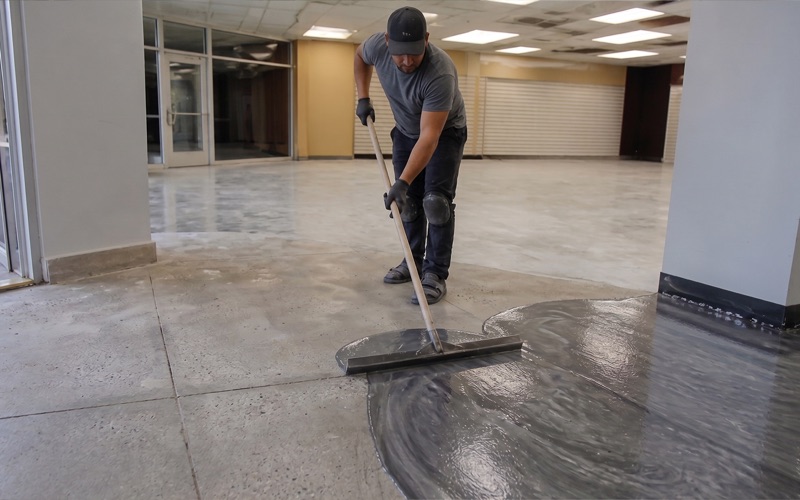
A coating-only job on an existing floor is finish work and does not trigger permitting on its own. Where flooring forms part of a wider commercial finish-out, it rides on that project’s permit instead. Establishing which case applies takes one question at the quoting stage.
Looking for epoxy flooring closer to Huntsville? See Epoxy Flooring in Huntsville.
Clay That Does Not Expand, and Why
The Mechanism Is in the Chemistry
Almost the entire community sits on low-movement ground, with nothing measured as reactive at any depth and a maximum extensibility well below the threshold where movement becomes a design consideration.
The reason is not that there is no clay here. It is that the clay is a different mineral. The dominant local soils are kaolinitic, and kaolinite is a non-expanding clay mineral, where the heavy clays further west are smectitic and expand as they take up water.
That is a chemical distinction rather than a matter of degree, and it is why a general regional assumption about Texas clay simply does not transfer to this community. Two soils can both be called clay and behave in completely different ways, and the mineral name is what separates them.
Sand Over Non-Expanding Clay
Beyond the mineralogy, the profile here is genuinely sandy. The dominant series carries very low clay content through several feet of depth, and a secondary one is even lower.
That combination, low clay content and a non-expanding mineral where clay does occur, is about as favorable as ground gets in this part of Texas for anything bearing on a slab. Ground like this removes the largest variable that complicates this trade elsewhere in the region.
None of the local soil descriptions here contains the kind of seasonal cracking statement that appears throughout the heavier ground further west. That absence is a finding rather than a gap in the research. The descriptions were read rather than skipped, and the absence is what they say.
Water Is Still Worth Checking
Stable ground does not mean dry ground. Some of the local profile carries a layer that perches water at depth, and a poorly drained minority holds it much closer to the surface. Water beneath a slab drives vapor upward through the concrete regardless of whether the ground itself is moving, and vapor is what breaks the bond between a coating and a floor.
So moisture testing stays in the scope. Calcium chloride testing and relative humidity probes give the figures that a product’s own thresholds are written against, and they describe the slab rather than the ground beneath it. A stable site with a wet profile is still a site where a coating can fail from underneath.
Manufactured Homes and Detached Houses
An Ownership-Dominated, Two-Type Market
Around nine tenths of occupied homes here are owner-occupied, which is among the highest rates anywhere in this service area. There is no multi-family stock in the community at all.
The housing divides between site-built detached houses and manufactured homes, with manufactured homes making up a substantial share. Those two present completely different concrete to a coatings contractor.
That split shapes almost every enquiry here, and it is the first thing we establish when somebody calls. It changes the specification, the product and frequently the price.
What Each Type Presents
A site-built house typically brings a conventional attached garage: an interior slab under controlled conditions, with the usual questions about previous coatings, sealers and moisture.
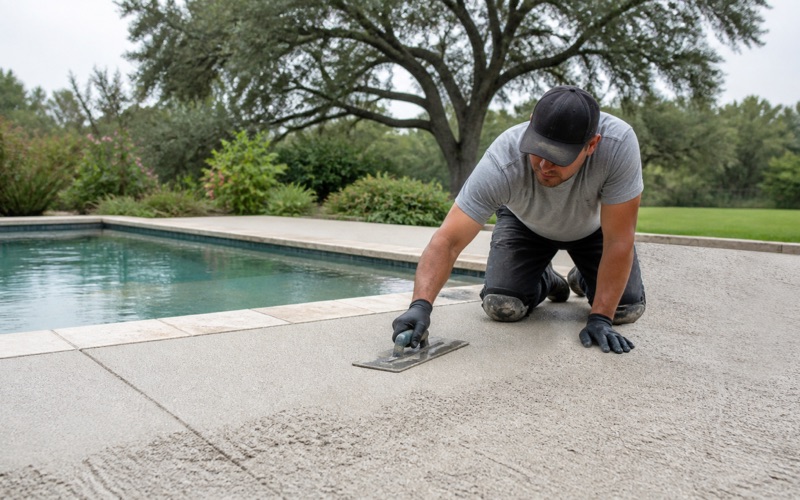
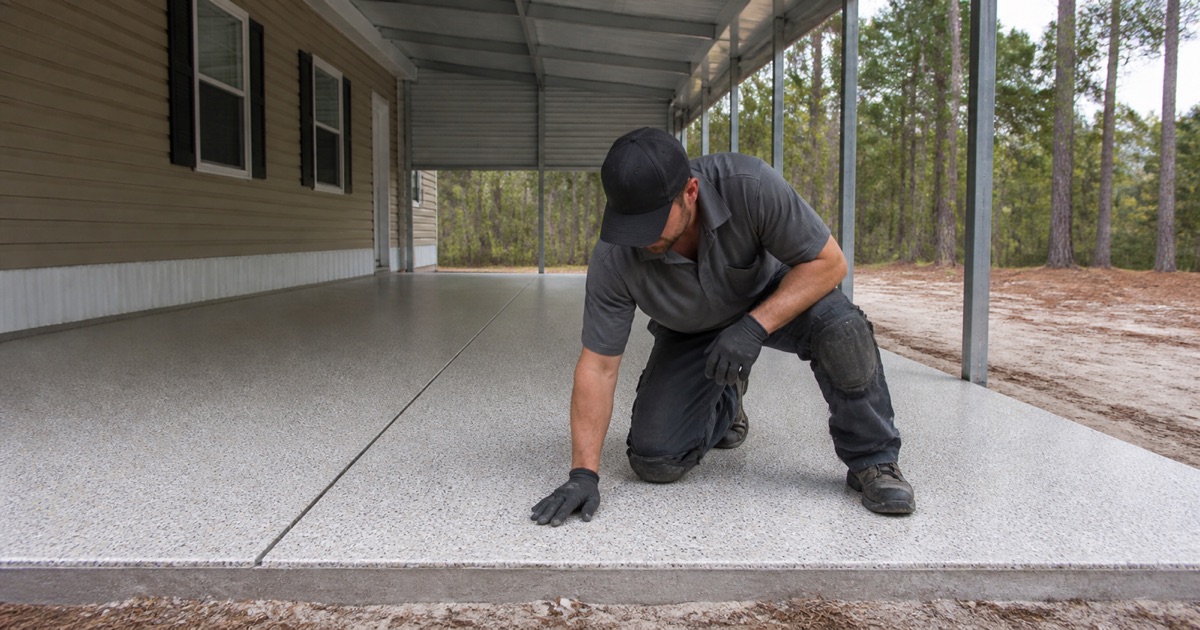
A manufactured home usually brings a pad, a carport slab or a patio, which are exterior or semi-exterior surfaces facing direct sunlight, rain and thermal cycling. Those rule out an interior-grade topcoat and call for an ultraviolet-stable polyaspartic or polyurea finish instead.
Quoting one as though it were the other is the most common way a phone estimate turns out wrong on arrival, which is why we visit before pricing. A five minute look at the concrete answers questions a phone call cannot.
Drainage Around an Exterior Pad
An exterior slab is built to shed water away from the structure, and a coating reproduces the existing fall exactly, including any low spot that already ponds.
Where a pad holds water we say so and price the correction as its own scope rather than laying a new surface over a drainage problem. On ground that already perches water, keeping surface water moving away from a building matters more than any product choice.
Checking fall before quoting takes minutes and prevents the most predictable exterior failure there is. Correcting fall is a separate scope and it should be priced as one rather than absorbed quietly.
Commercial Work and Who Reviews It
The Local Commercial Base
The commercial stock here is small and specific: automotive workshops, storage, a couple of retail premises and food service, alongside an industrial-platted tract. There is a fire station inside the community and the local school district operates a campus here.
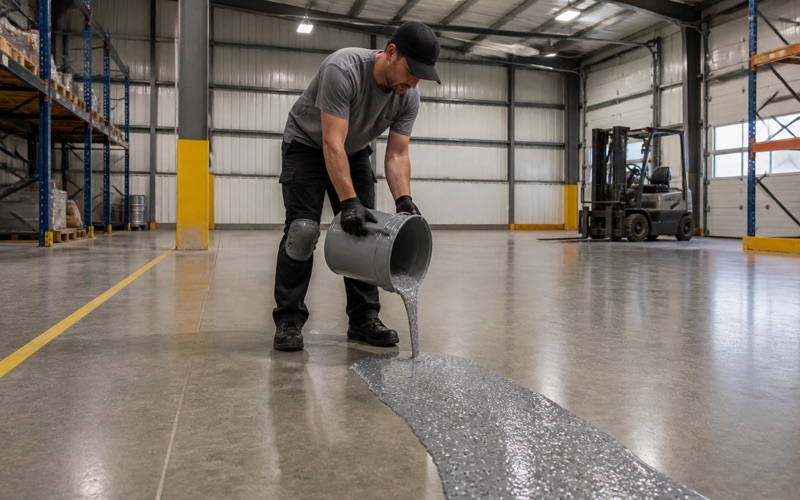
That shape tells you what commercial flooring work actually looks like locally. Workshop bays, storage floors and food service areas rather than warehousing or manufacturing at scale. Specifying for what a building actually does, rather than for what its category suggests, is most of the value here. Each of those has a different specification, and coating them all to one standard would mean spending money in the wrong places.
Service Bays and Workshop Floors
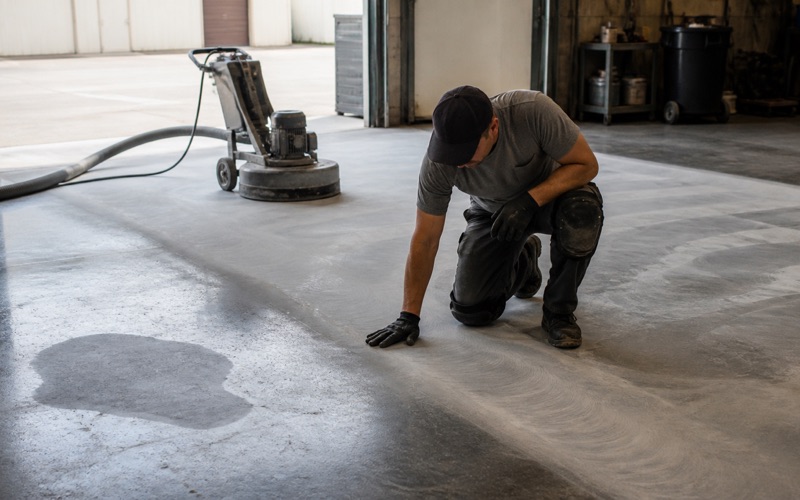
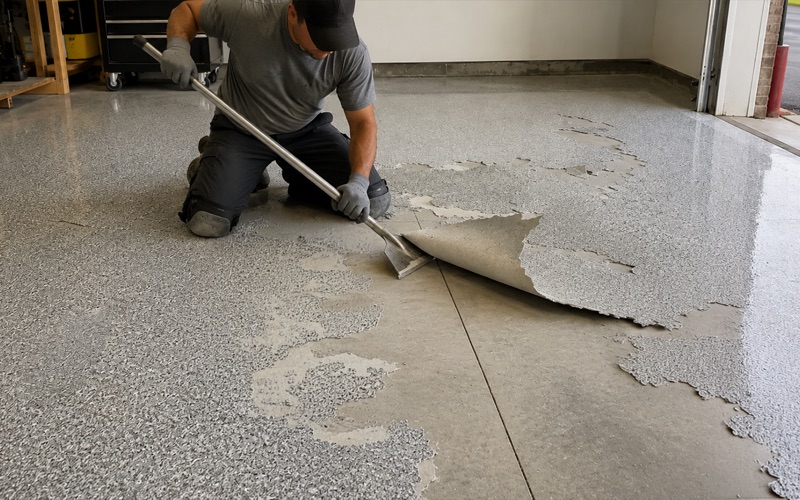
Automotive work brings hot tire pickup, dropped tools, fuel and solvent exposure. A coating that is underspecified for vehicle traffic, or one loaded before it has cured through, lifts in patches under tires. The answer is a system rated for that duty and a cure schedule that is genuinely respected rather than compressed to get a bay back into service.
We put both return-to-service dates in writing at handover for exactly that reason, because early loading is the most common avoidable failure on a workshop floor. Hot tire pickup is entirely preventable and it is almost always a scheduling failure rather than a product one.
Food Service Floors
Where a floor serves food preparation, the Food Code that Texas adopts sets the requirements: smooth, durable, easily cleanable and nonabsorbent where the floor gets wet, with a coved junction at the walls closed to a tight tolerance.
The apparent conflict between a smooth floor and a slip-resistant one is resolved in the code itself, which explicitly permits antislip applications used for safety reasons. That carve-out is what allows a floor that is genuinely safe underfoot and still passes.
Urethane cement is usually the right specification in a working kitchen, because it tolerates heat, steam and washdown far better than a standard epoxy build. It is the correct answer rather than an upgrade. We will say when a service area genuinely does not need it, since a dry store room is a different case from a cook line.
- 20+ Years in the Brazos Valley
- Insured & Registered
- Free Written Proposals