College Station Epoxy Flooring installs epoxy flooring in Magnolia, and this town deserves a straight answer that a lot of contractors will not give it. The ground here does not move, and a quote written around soil movement would be selling protection against something that is not present.
More than ninety percent of the city is low-movement ground throughout its profile. Of the nine soil series covering the large majority of the town, not one reaches the threshold used to identify movement-prone material anywhere in its profile, at any depth. We report that as a finding rather than as a selling point, because it is simply what the published records say about this ground.
That is unusual for this region and it is worth being explicit about. The real questions here are drainage and slab condition, and both are entirely answerable.
Ground That Does Not Move Here
What the Measurements Actually Show
The soils covering roughly nine tenths of this city are dominated by an order associated with weathering and leaching rather than with seasonal volume change. Their published extensibility values run low across the board, well beneath the level at which movement becomes a design consideration.
We checked each dominant series individually rather than relying on an area-weighted average, because an average can conceal a reactive minority. It did not conceal one here. Every series came back low. Checking individually costs an hour and it is the difference between a measured statement and a repeated assumption.
So a floor in Magnolia is being laid on ground that behaves consistently through wet winters and dry summers, which removes the largest single variable that complicates this work elsewhere in the region. That is genuinely good news for anybody buying a floor here and it should be reflected in the price rather than hidden.
Why That Is Worth Saying Out Loud
Plenty of contractors working across this region carry one mental model of Texas ground and apply it everywhere. In a town like this that model is simply wrong, and applying it produces a specification aimed at a problem the site does not have.
Charging for engineering that achieves nothing is the polite version of the failure. The less polite version is that it crowds out attention from the things that genuinely will decide whether the floor lasts.
We would rather write a simpler, cheaper proposal that addresses the real risks than an impressive one aimed at an imaginary problem. A quote that solves the wrong problem is not merely expensive, it is a distraction from the one that will actually cost you.
What Still Decides the Job
Stable ground removes one risk and leaves the others exactly where they were. A slab can still carry moisture, still have a sealer on it, still have been power-floated to a hard closed surface that nothing will key into.
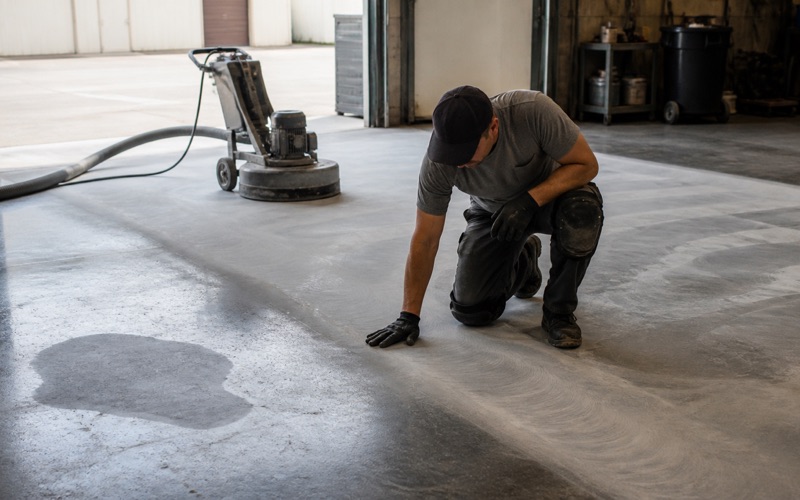
Preparation remains the single largest predictor of whether a coating is still bonded in five years, on any ground at all. Nothing about a stable site makes mechanical profiling less necessary.
So the assessment here focuses on the concrete rather than on what is beneath it, which is a more tractable set of questions and usually a cheaper answer. Simpler ground should produce a simpler proposal, and where it does not it is fair to ask what the difference is buying.
Looking for epoxy flooring closer to Rockdale? See Epoxy Flooring in Rockdale.
Drainage Rather Than Movement
Poorly Drained Ground Is the Real Constraint
While the ground here does not change volume, a meaningful share of it drains poorly. Several of the dominant soils sit in the slowest drainage groupings, on very gentle slopes, and one is mapped as frequently ponded.
Roughly a fifth of the city sits on ground of that character. Water that does not drain away accumulates, and where it accumulates beneath a slab it drives vapor upward through the concrete.
That is the local mechanism worth designing against, and it is a completely different problem from the one most of this region worries about. Two towns half an hour apart can genuinely need opposite specifications, and this is one of those pairs.
What Vapor Drive Does to a Coating
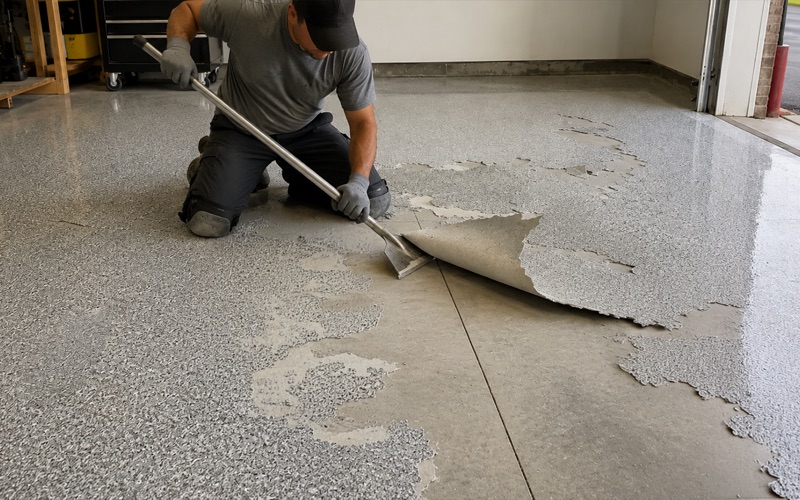
Where vapor pressure from below exceeds what a coating can resist, the result is blistering, pinholing, or a floor that lifts away in sheets. It is the most common failure we are called out to inspect and it is entirely preventable.
Prevention means either a system rated for the vapor drive actually present or a moisture-mitigation primer beneath it. Both are quantified by testing rather than estimated by eye.
Calcium chloride testing and in-situ relative humidity probes produce the figures a product’s own thresholds are written against, and those figures decide the specification rather than informing it loosely. Testing is quick and it is not expensive relative to the cost of installing a floor twice.
Surface Water and Fall
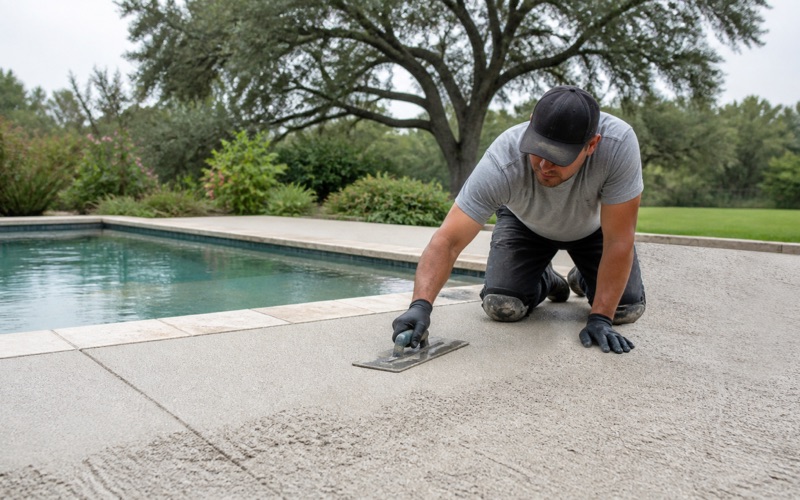
Outside, drainage is equally decisive. A pad or driveway is built to shed water, and a coating reproduces the existing fall exactly, including any low spot that already ponds.
Where a slab holds water we say so and price the correction as its own scope rather than laying a new surface over the problem. Standing water is the fastest way to age an exterior finish anywhere, and on poorly drained ground it is a recurring condition rather than an occasional one.
Checking fall before quoting takes minutes and it prevents the most predictable exterior failure there is. Fall is also far easier to correct before a coating goes down than afterwards.
New Slabs and What They Still Need
An Unusually Young Housing Stock
The housing here is genuinely new. The median build year sits in the late two thousands, well over a fifth of the stock has gone up since 2020, and only a handful of units predate 1960.
That is close to the opposite of most towns we cover, and it changes the shape of the work. There is very little recoat and repair market here, because there are very few old floors to recoat.
What there is instead is a large volume of newer slabs that have never been coated at all, which is a different and generally easier proposition. It also means most enquiries here are first coatings rather than repairs, which changes what the conversation is about.
Why a New Slab Is Not Automatically Ready
A new slab brings its own considerations. Concrete needs time to cure before it will accept a coating, and a slab poured recently may still be releasing moisture from the pour rather than from the ground.
Curing compounds are the other common issue, and they are applied precisely to slow moisture loss. A coating laid over one is bonded to the compound rather than to the concrete, and it will let go with it.
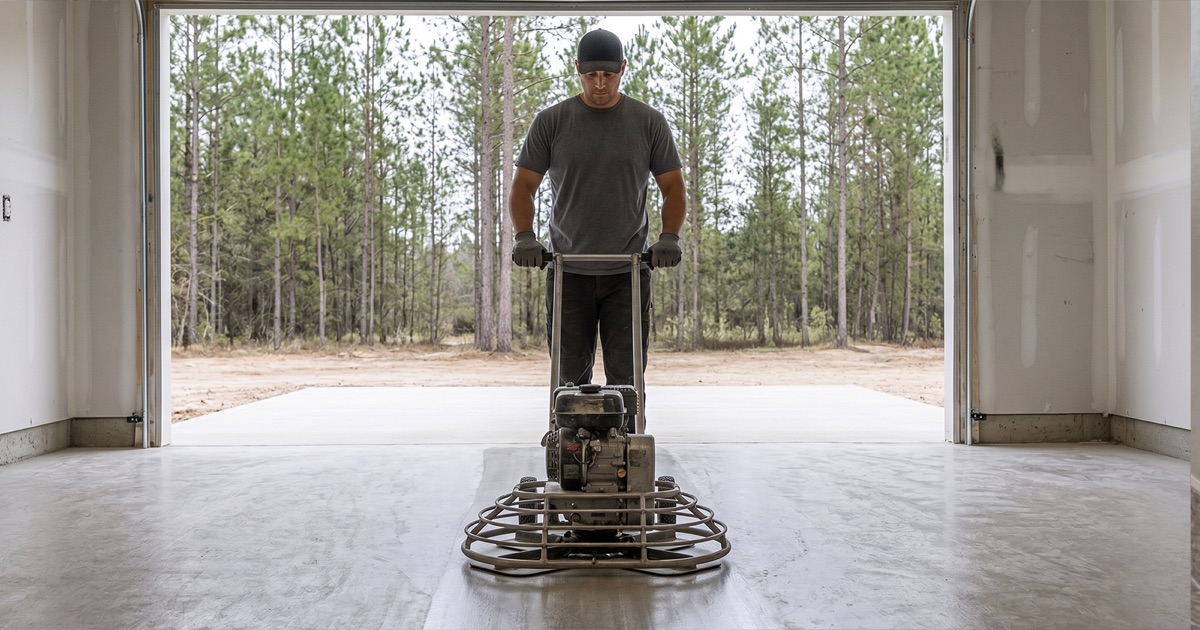
Both are handled the same way: test, then grind to a measured profile. New concrete needs opening up exactly as old concrete does. People are frequently surprised that a brand new slab needs grinding at all, and it is one of the more common misunderstandings on new construction.
Working With a Builder’s Timeline
New construction floors often sit inside a wider program with other trades, which changes the scheduling rather than the specification. A floor coating is finish work and generally comes late in a sequence.
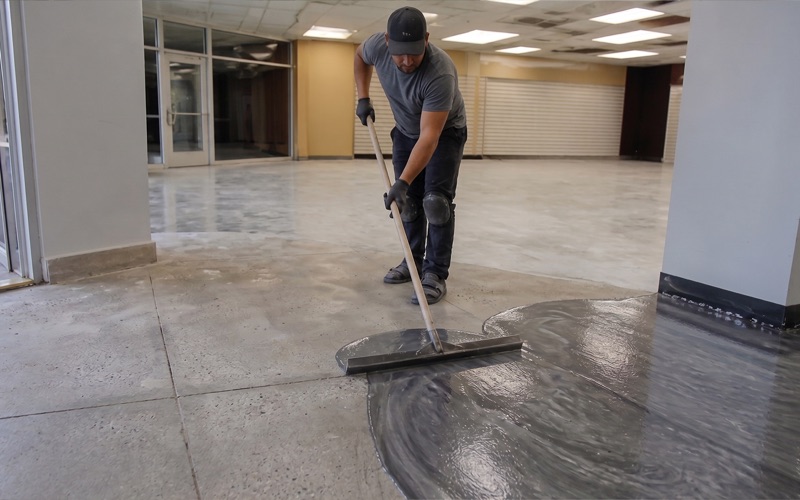
Where flooring forms part of a commercial finish-out it rides on that project’s permit rather than carrying one of its own, since finish work of this kind is exempt from permitting in its own right.
We ask what else is happening in a space rather than only what is happening to the floor, which is usually enough to establish where a job sits in a program. Coordinating with other trades early avoids the situation where a finished floor is used as a work platform.
What the City Asks of a Contractor
Registration and a Substantial Insurance Minimum
The city requires contractors to register before pulling a permit. There is no fee attached, but there is a high liability insurance minimum, with the city named on the certificate.
Setting a figure that high is a deliberate filter rather than an administrative formality. It excludes anybody operating without serious cover, which is a reasonable thing for a city to do and useful information for a property owner. It is also easy to verify, which is more than can be said for most claims in this trade. We carry cover meeting that requirement along with workers compensation and a Texas sales and use tax permit, and we are content for any of it to be verified.
An Asbestos Survey on Commercial Renovation
The city’s commercial submittal requirements include an asbestos survey for renovation and demolition permits. That aligns with the state rule placing the survey duty on the building owner before suspect material is disturbed.
Old floor covering and the black mastic beneath it are exactly what that provision concerns. We raise it before a grinder goes anywhere near a commercial slab, because it is the owner’s obligation and it has to happen first.
Raising it early occasionally delays a start date. It is considerably better than the alternative. Discovering suspect material mid-job stops the work entirely and costs far more than the delay would have.
What Goes Into the Proposal
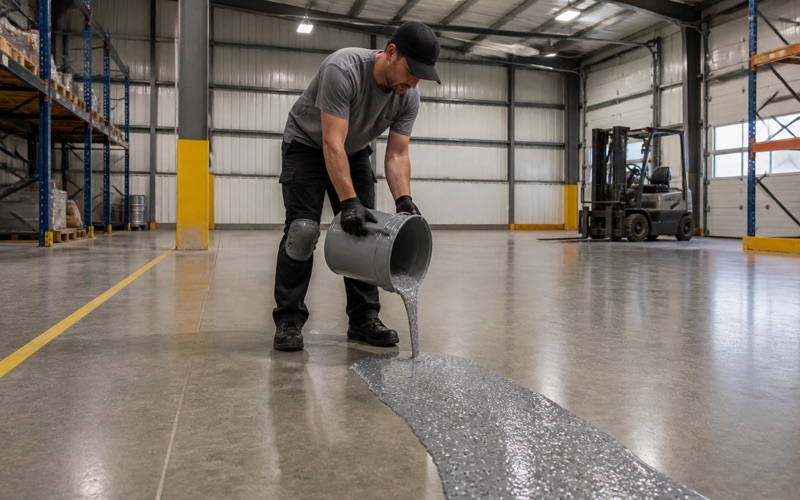
Texas issues no state license for flooring, coatings or painting work, so instead of a license number we show verifiable cover and registration. The proposal then names the product, the system build and the mil thickness.
That specificity lets the finished floor be measured against what was sold, which is awkward for a contractor and useful for everybody else. It is the reason we write it that way. Where we believe a coating is the wrong answer for a particular slab, the proposal says so instead of quoting the work anyway.
- 20+ Years in the Brazos Valley
- Insured & Registered
- Free Written Proposals