College Station Epoxy Flooring installs epoxy flooring in Madisonville, a town whose ground is unusually predictable compared with most of the area we cover. That is worth saying plainly, because predictability is genuinely valuable when specifying a floor.
Across a great deal of this region, soil conditions vary sharply from one part of a town to another, and a specification that suits one address is wrong a mile away. Madisonville does not work like that. Its profile is close to uniform, and it is uniform in a specific and useful way.
The town also does something unusual with contractors: it operates a voluntary register, verifies insurance, and publishes the resulting list to residents twice a month. In a trade with no state licensing at all, that is a more meaningful credential than most.
An Unusually Consistent Claypan Under This Town
What the Measurements Show
Effectively none of Madisonville carries reactive material sitting right at the top of the profile, while more than eighty percent has reactive clay lying beneath a non-reactive cap. That is the most consistent claypan profile measured anywhere in this service area.
Consistency of that kind is unusual. In most towns nearby the picture is mixed, with reactive ground concentrated in one quadrant or scattered across several map units, and a specification has to account for which part of town a property sits in. Here the answer is broadly the same across the town, which simplifies the assessment considerably and makes it much harder to get the specification badly wrong.
Why a Cap Changes the Problem
Where reactive clay lies under a non-reactive layer, seasonal moisture change reaches it slowly and indirectly rather than acting on it straight from the weather. The cap buffers the cycle that drives movement.
That is meaningfully better than reactive material lying directly beneath a slab, but it is not the same as inert ground. The clay is still present and still responds to a wet winter and a dry summer; what changes is how much of that reaches the concrete and how quickly.
Cracking in that situation begins at the top of the clay horizon and works downward rather than opening at ground level, which is why the absence of visible surface cracking is not evidence that a site is stable.
What a Graded Lot Does
The published series descriptions for this kind of ground carry an important clause: where the surface layer is eroded or thin, the soil cracks all the way up. Site grading does exactly that deliberately.
A lot cut and scraped before the slab was poured may have lost most of its protective layer, which means the general soil picture describes conditions that no longer exist on that property. It can behave far more like a surface-reactive site than the map suggests. So we ask about site history and look for evidence in the existing slab, because on ground this consistent the exceptions are almost always man-made rather than natural.
Looking for epoxy flooring closer to Hempstead? See Hempstead Epoxy Flooring.
How the City Vets Who Works Here
A Register That Is Encouraged and Free
Madisonville encourages contractors working inside the city limits to register, and registration costs nothing. That is a deliberately low barrier, and it changes the character of the scheme entirely.
Because there is no fee and no compulsion, the list is not a revenue exercise. What the city does instead is verify that a registering contractor’s state licensing where applicable and liability insurance are current at the point of submission.
It then publishes the vetted list to residents twice a month. For a homeowner trying to work out who is legitimate, that is a genuinely useful resource and it costs them nothing to consult.
Why That Matters in This Trade
Texas issues no state license for flooring, coatings, painting or general contracting. Anyone in this trade claiming to be licensed is describing something else, and a homeowner has very little to check against as a result.
A city-verified register partially fills that gap. It confirms insurance was current and that somebody took the trouble to submit documentation, which is a low bar but a real one and considerably better than nothing.
We would rather point customers at a check they can perform themselves than ask them to take our word for it. An independent list published by the city is exactly that kind of check.
What We Carry Regardless
Wherever we work, we carry general liability cover, workers compensation and a Texas sales and use tax permit, the last of which is a requirement for nonresidential repair and remodeling work rather than a mark of quality.
None of those is a license and we do not present them as one. They are the verifiable facts available in a trade where the usual credential does not exist, and we would rather name them precisely than blur the distinction. The proposal then does the rest of the work by naming the product, the system build and the mil thickness, so what was quoted can be measured against what was installed.
Older Madisonville Houses and Their Slabs
A Genuinely Old Housing Stock
The housing here is old by the standards of this region. The single largest cohort was built in the nineteen forties, more than a quarter of the stock predates 1950, and close to sixty percent predates 1980, with effectively nothing built in the last few years.
That profile is the most practical fact about working here. Most slabs we touch in this town were poured before under-slab vapor retarders were standard practice, and many were poured before a good deal else was standard either. It also means a high proportion of properties have had something done to the floor already, whether that is a coating, a sealer, a patch or a covering that was later removed.
What Turns Up on an Older Slab
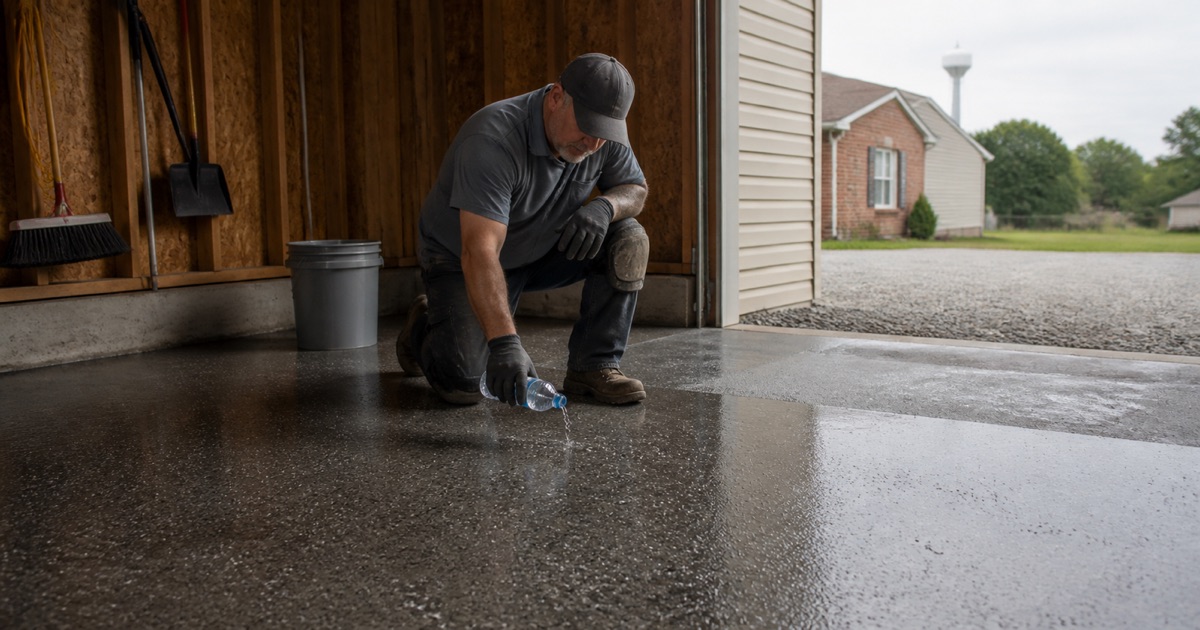
Sealers and curing compounds are the most common find, and they are frequently invisible until water is dropped on the surface and beads instead of soaking in. A coating bonded to a sealer is only ever as good as that sealer’s grip on the concrete.
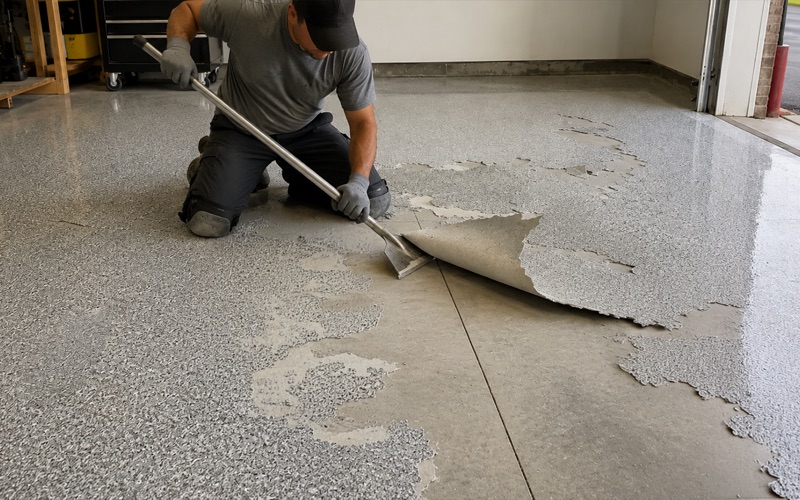
Old adhesive from a removed covering, previous garage paint and store-bought kits all come off before anything else happens. That work is slower and dustier than preparing bare concrete, so it is quoted as its own line rather than folded into a rate.
Patches matter too, because a coating has to bond to the repair material as well as to the original slab, and the two do not always accept the same primer or behave the same way over time.
Moisture Testing on an Older Floor
On any slab we did not pour, moisture testing is written into the scope rather than offered as an extra. Calcium chloride testing and in-situ relative humidity probes produce numbers that a product’s own thresholds are written against.
That matters more on older concrete because there may be nothing under the slab to interrupt vapor rising from the ground. Where there is no retarder, the reading is the only reliable indicator of what a coating will be asked to hold back. Where the numbers require a moisture-mitigation primer, it appears in the proposal rather than arriving as a change order once the grinder is already running.
What the County Does and Does Not Do
No Building Permit Outside the City
Madison County issues no building permit at all, and that is a straightforward statement rather than an approximation. For a property outside the city limits there is no plan review, no inspection and no certificate at the end of the work.
That is a different situation from the city itself, which operates its own building department and adopts a full set of construction codes. Two properties a short distance apart can therefore sit under completely different regimes.
Knowing which applies matters most for anything structural or for a commercial finish-out. For an interior floor coating it changes very little, since finish work of that kind is exempt from permitting in any case.
Where the Floor Sits in All of That
Interior floor coating is finish work, and painting, tiling, carpeting and similar work sits on the exempt list wherever a building code has been adopted. A garage floor coating therefore does not carry a permit of its own.
Commercial tenant finish-out is a different matter, and where flooring forms part of a wider scope it rides on that project’s permit rather than standing separately. We flag that distinction at the quote so nobody is caught out. Asking what else is happening in a space, rather than only what is happening to the floor, is usually enough to establish which situation applies.
Why the Absence of Inspection Raises the Bar
Where nobody will inspect the work, the written specification carries all of the weight. That is true on any job and it is more true outside a city boundary, where there is no permit file and no inspection history for a future owner to consult.
So we record what we found on the slab, including moisture readings and anything discovered during preparation, and we name the system precisely enough that the finished floor can be checked against it. A written finding is harder to walk back than a verbal impression, which is the entire reason for putting it in the document rather than mentioning it on the day.
- 20+ Years in the Brazos Valley
- Insured & Registered
- Free Written Proposals