College Station Epoxy Flooring installs epoxy flooring at Lake Bryan for a community that is easy to misread from a distance. People hear the name and picture a reservoir with a boat ramp, and there is one, but there is also a settled residential area around it with its own housing stock and its own ground conditions.
That matters because the ground out here is not what covers most of Brazos County. The county reads as claypan country, with reactive clay sitting under a sandy cap. A meaningful share of this area does not follow that pattern at all, and the difference shows up in how the ground behaves through a dry summer. Anyone applying a countywide rule of thumb to a slab out here is describing somewhere else.
It also matters because there is no city hall here. That changes who has authority over building work, and it changes what a contractor can and cannot point to when you ask what rules apply. That absence is worth understanding before you hire anybody, not after.
What a Coating Job Looks Like Out at the Lake
A Real Residential Area, Not a Park
The housing here is overwhelmingly owner-occupied, and effectively all of the occupied stock is lived in year-round rather than used seasonally. That is a different customer from a weekend property, because the floors get daily use and the work has to fit around people who live there rather than around a visiting season.
It also means the garages and workshops are working spaces. They hold vehicles, tools and storage that has accumulated over years, and clearing a slab completely is usually the part of the schedule that needs the most notice. A half-cleared garage on the morning of a grind costs a day, and the day is usually unrecoverable in a scheduled week. We agree who moves what well before the crew arrives.
Half the Stock Is Manufactured Housing
Around half the housing here is manufactured, and all of the site-built detached houses are owner-occupied. That split shapes the work more than anything else about the area, because a manufactured home and a site-built house present completely different slabs to a coatings contractor.
A manufactured home may have a poured pad, a garage or carport slab, or a patio, and each of those is an exterior or semi-exterior surface with its own exposure. A site-built house brings a conventional attached garage with a different set of questions. We quote them differently because they are different jobs. Confusing the two is the most common reason a quote given over the phone turns out to be wrong on arrival.
Distance Changes the Scheduling, Not the Standard
Working out here means planning materials and crew for a site that is not five minutes from a supplier. Batch sizes, sequencing and the number of people on site all get worked out before the day rather than adjusted on it, because a return trip for a missed item costs a working window rather than twenty minutes.
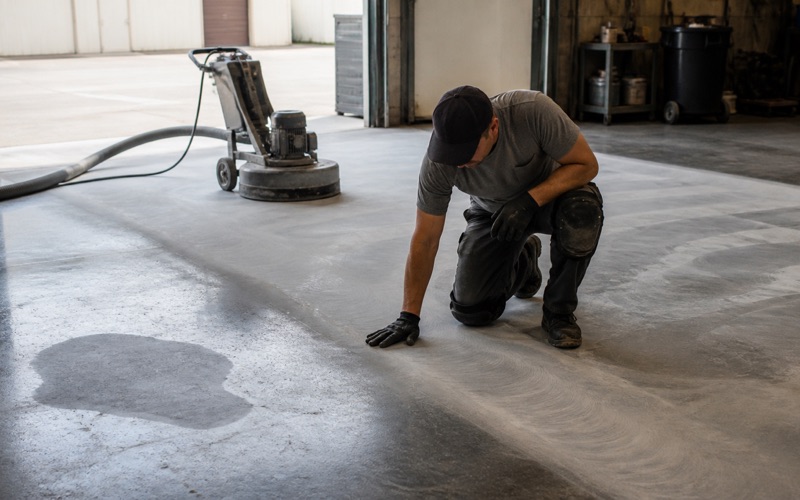
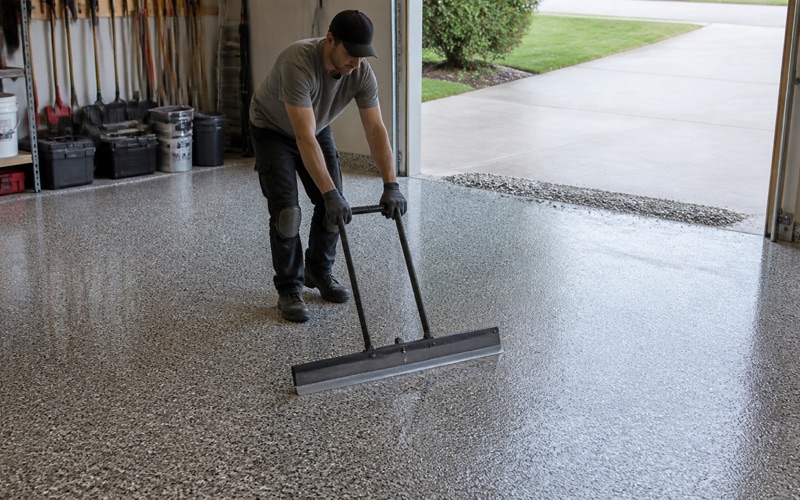
None of that changes the standard of the work. The slab is opened mechanically, the moisture is tested, and the proposal names the product and the build. What changes is that the plan has to be right before we leave the yard. That planning is invisible when it works and extremely visible when it does not.
Looking for epoxy flooring closer to Navasota? See Navasota Epoxy Flooring.
Luling Clay and Cracks That Stay Open
Ground That Behaves Differently From the County Norm
A substantial share of this area is mapped as Luling clay, and it is genuinely different material from the claypan series that dominate the surrounding county. Its published description states that its cracks remain open for more than 90 cumulative days during most years, which is a statement no upland series inside the hub city carries at all.
That is not a small distinction. It describes ground that opens and closes on a seasonal cycle, every year, rather than clay sitting quietly under a protective cap of sand. A homeowner here is far more likely to have watched it happen in a yard or a driveway than a homeowner in town.
What Seasonal Cracking Does to a Slab
Where ground moves on that cycle, the slab above it moves with it, and a coating bonded to that slab moves too. A resinous floor is a film. It follows the concrete and it does not resist, bridge or absorb what the ground underneath is doing, whatever a competing quote may imply.
What we do instead is treat cracks according to what they are. A crack that has settled gets filled and disappears under the finish. A crack that is still working is treated as a joint, filled with a semi-rigid polyurea that supports the edges while permitting movement, and flagged in advance as something that may reappear. Setting that expectation in writing is the only honest way to sell a floor over ground that moves.
Testing Rather Than Assuming
Because the ground here is not the county default, we test rather than carrying an assumption out from town. Moisture readings with calcium chloride and relative humidity probes tell us what a specific slab is doing, and that measurement is what the system specification is built against.
The alternative is applying a hub-city answer to ground that does not match it, which is how a floor gets specified for the wrong problem entirely. On this side of the county that is a real risk rather than a theoretical one. The county’s general character is genuinely a poor guide to this particular area.
Who Actually Has Authority Out Here
No City Government At All
There is no city hall, no municipal building department and no city inspector for this community. Brazos County is the authority, and in the unincorporated county there is no building permit, no trade permit, no remodel or finish-out permit, no zoning and no certificate of occupancy.
That surprises people who assume a permit is a baseline safeguard. Out here it is genuinely absent, which puts the entire weight of quality control on the contractor’s own standards and on what a customer is willing to check for themselves. Some people find that reassuring and some find it alarming; either way it is the actual situation.
What to Ask For Instead of a Permit
Since there is no inspection regime to fall back on, the substitutes are documentary. Texas licenses no flooring contractor at all, so a license number is not available from anyone honest in this trade. What is available is general liability cover, workers compensation, a Texas sales and use tax permit and a proposal specific enough to hold somebody to.
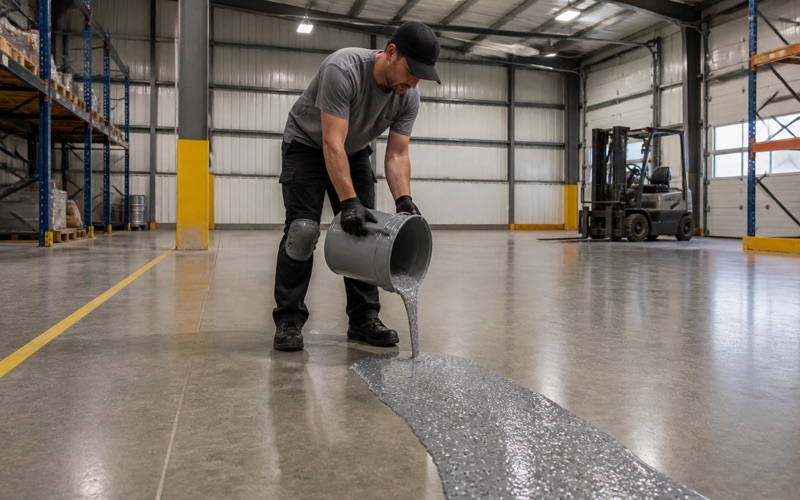
We name the product, the system build and the mil thickness in writing for exactly this reason. Where no inspector is going to look at the work, the written specification is the only thing that makes it checkable afterward. A specification you can measure against the finished floor is worth more than a warranty you would have to argue about.
Why We Put the Findings in Writing
Every proposal records what we found on the slab, including moisture readings and anything we discovered about the surface. That record is more valuable here than almost anywhere else we work, because there is no permit file and no inspection history for a future owner to consult. In ten years that proposal may be the only record that the slab was ever tested.
It also keeps us honest. A written finding is harder to walk back than a verbal impression, which is the point of writing it down rather than mentioning it on the day.
Manufactured Homes and Site-Built Houses Need Different Answers
Pads, Carports and Patios
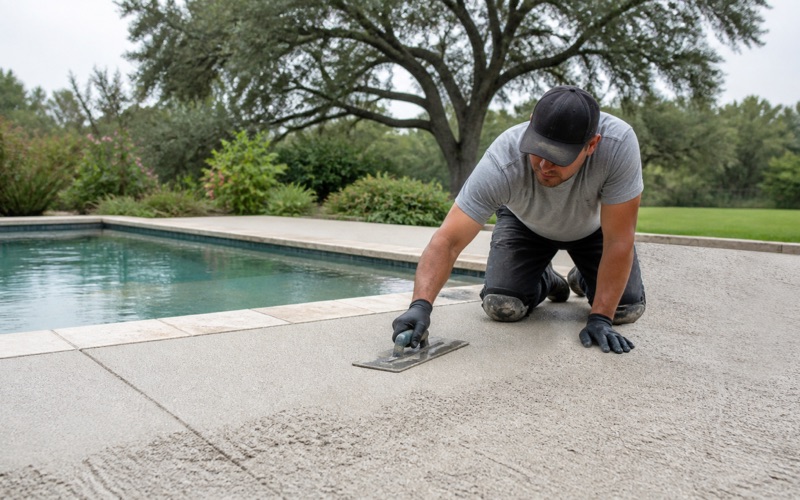
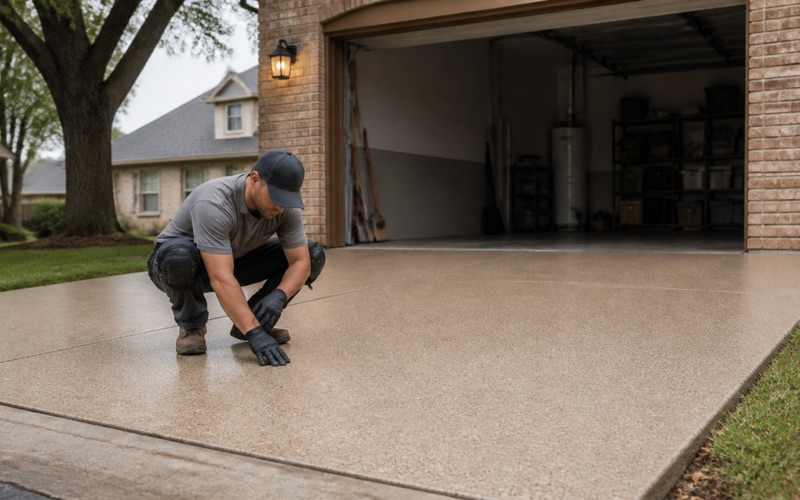
A manufactured home usually presents exterior or semi-exterior concrete rather than an enclosed garage, and that changes the specification completely. Outdoor slabs take direct sunlight, rain and thermal cycling, which rules out an interior-grade epoxy topcoat and calls for an ultraviolet-stable polyaspartic or polyurea finish instead.
Drainage matters more on these slabs too. A pad that sheds water away from the home is doing a job, and a coating must not interfere with that fall or create a low spot that holds water against the structure.
Attached Garages on Site-Built Houses
A site-built house here brings a conventional attached garage, and those are the straightforward jobs: an interior slab, controlled conditions, and the usual questions about depth to clay, moisture and whatever coating may already be on the floor.
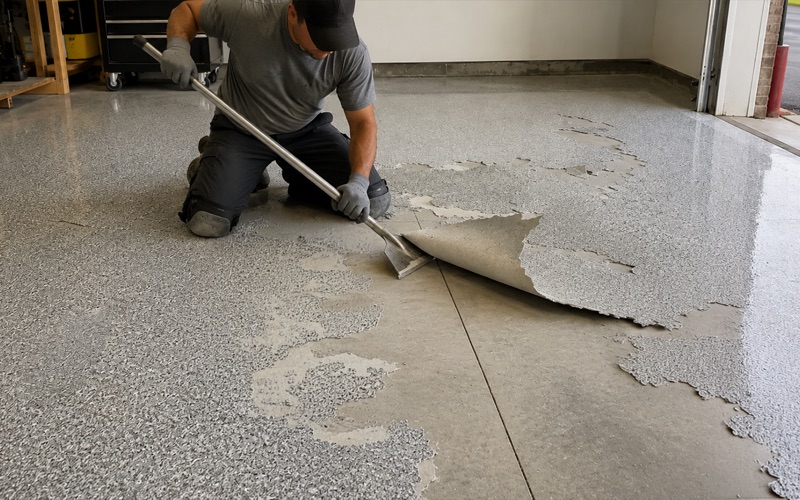
The one thing that recurs on older detached properties is a previously applied sealer or a store-bought kit. Both come off before anything else happens, and both are quoted as their own line rather than absorbed into a square-foot rate.
Choosing One Standard Across a Property
Where a property has both a garage and exterior concrete, people usually want them to match. They can be made to look consistent, but they should not carry the same system, because the exposures are genuinely different.
We specify each surface for what it faces and then coordinate color and texture so the result reads as one scheme. That is a better outcome than using one product everywhere and watching the exterior fail first.
- 20+ Years in the Brazos Valley
- Insured & Registered
- Free Written Proposals