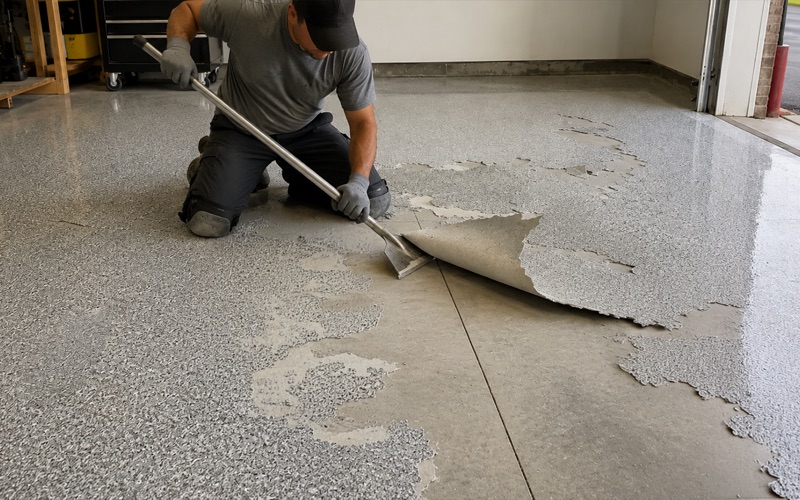
College Station Epoxy Flooring installs epoxy flooring in Huntsville, which presents the most varied ground of anywhere in this service area. That is not a figure of speech. Deep sand and genuinely heavy clay both occur inside this one city limit, in map units a short distance apart.
At one extreme sits a soil that is roughly four feet of sand at around seven percent clay, in the freest-draining hydrologic group there is. At the other sits material running past half clay content with a plasticity index in the forties, in the slowest-draining group, movement-prone right from the ground surface.
There is no single answer to what is under a Huntsville slab. A site visit here does more work than in any other town we cover, and quoting from an address alone would be guessing rather than estimating.
Sand and Heavy Clay Inside One City Limit
Two Extremes in One Town
The spread here is genuinely wide. Something over a tenth of the city carries material that is movement-prone at the surface, around a third has it beneath a non-reactive cap, and another third is low-movement throughout its profile.
Those three populations exist side by side rather than in a gradient, and the remainder is ground with no published data at all. Very few towns present that much internal variety inside one boundary.
So the useful question is never what Huntsville soil is like. It is what is under this particular building, and that has to be established rather than assumed from anything regional.
Where the Extremes Concentrate
The pattern is not random. Movement-prone material concentrates toward the northwest of the city while the sandy soils concentrate toward the southeast, which gives a rough orientation without giving a reliable rule.
Rough orientation is useful for knowing what to expect on the way to a job. It is not sufficient for a specification, because the boundaries are irregular and individual properties sit inside pockets that do not follow the general trend at all. We treat the pattern as a prior and the site visit as the decision, which is the only defensible approach on ground this mixed.
Clay That Starts Very Shallow
One series mapped here is worth singling out. It puts material of around half clay content, with a plasticity index approaching forty, only about four inches below the surface.
Four inches is shallow enough that ordinary site work reaches it, and shallow enough that a slab bearing on it is effectively bearing on the movement-prone material rather than on any buffer above it. Where that series is present the specification changes substantially, which is precisely why identifying it matters more than any product decision that follows from it.
Looking for epoxy flooring closer to Bryan? See Epoxy Flooring in Bryan.
The Seasonal Cracking Question
This Is the One Town Where It Applies
Across most of this service area, no local soil series carries a statement about cracks staying open for an extended part of the year. Huntsville is the exception, because two of the heavier series mapped inside the city limits do carry one.
Those series describe ground that opens as it dries and closes as it wets, on a cycle repeating annually and indefinitely rather than resolving once. That is a permanent property of the site rather than a construction-era defect.
It is worth being precise about this. It applies to specific ground within this city and not to the city as a whole, and it does not transfer to the towns nearby.
What That Means for a Floor
A resinous floor is a film bonded to concrete. It follows the slab exactly, and no system at any price bridges, absorbs or resists movement in the ground beneath it. Any quote suggesting otherwise is describing something its own warranty will exclude.
What a good specification delivers instead is a floor that copes with movement rather than one pretending it will not happen: live cracks treated as joints, semi-rigid fillers supporting both edges, and honest warning in advance that a working crack may telegraph through again. Saying that before the job rather than after a crack appears is the difference between a known limitation and a complaint nobody can resolve.
One Published Figure Disagrees With Itself
Worth noting for anyone who goes looking: the published data for one of the heavier series here carries two different extensibility values depending on which source is consulted.
We record both rather than picking the more dramatic one or averaging them into a figure appearing in neither source. Averaging two measurements is how a number nobody published ends up being quoted as fact.
Where a figure matters to a specification we say which source it came from. Where it does not, we leave it out rather than decorating a proposal with it.
Institutional and Commercial Floors
An Unusually Concentrated Employment Base
Huntsville’s employment is dominated by institutions to a degree few towns match. Its largest single employer accounts for well over a quarter of total city employment on the city’s own audited figures, and the top ten together account for more than half of it.
That concentration shapes the commercial flooring market here. Institutional and public-sector buildings make up a far larger share of the non-residential stock than they would in a comparable town, alongside a university presence and a hospital. Those buildings are specified differently from private commercial work, and they operate on fixed calendars that determine when work can happen at all.
What Institutional Floors Demand
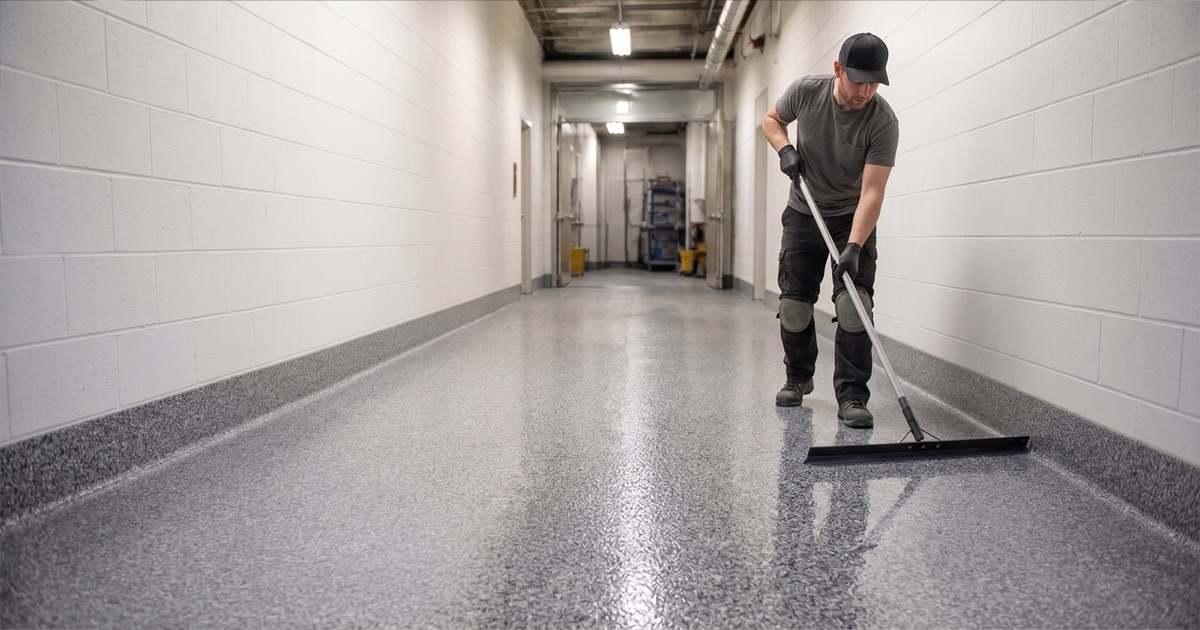
Floors serving large populations face concentrated traffic on defined routes, frequent cleaning with aggressive chemistry, and stretches where a building simply cannot be disturbed for any reason.
How a building cleans its floors tells us more than how many people walk on them. Daily washing with institutional-strength chemistry asks for chemical resistance first, and it asks for a surface with no interruptions in it, since anywhere the finish stops is somewhere soil gathers and stays.
Coved bases, sealed penetrations and properly detailed thresholds account for most of the labor on that work. They are also the first items cut from a cheap quote and the first to fail in service.
Scheduling Against a Fixed Calendar
Institutional work happens in the windows when a building is empty, and those windows do not move. The handover date functions as part of the specification rather than as a target to aim at.
We build the program backwards from the reopening date rather than forwards from a start date, and where a window is genuinely tight, fast-cure systems exist for that constraint rather than as an upsell.
That also means assessment has to happen well in advance. Finding a moisture problem a week before a shutdown is a far worse position than finding it several months out.
Restaurant Floors and When a Review Is Triggered
The City Runs Its Own Food Program
Unlike much of this region, where a county health district handles food establishment permitting, this city permits and inspects food establishments itself and runs several hundred inspections in a year.
That means the plan review and the inspector are both municipal, which changes who you deal with and how the process runs. For a restaurant owner it is a single local point of contact rather than a county office elsewhere. For a flooring contractor it means finish requirements are reviewed locally and specifically, which raises the value of getting the specification right the first time.
A Finish Schedule That Names the Floor
The city’s own plan review packet includes a finish schedule requiring separate entries for the floor and for the floor-to-wall juncture across a list of named room types, and it states explicitly that a response of “see plans” will not be accepted.
That is a considerably more demanding requirement than most jurisdictions impose, and it means the floor specification has to be settled and written down before a review rather than resolved on site afterwards. It also means a vague flooring line in a submittal will come back, which is a delay nobody needs when a fit-out is already on a schedule.
Change of Ownership Triggers It
The requirement that catches people is that a change of ownership triggers a full plan review. Buying an existing restaurant is not a continuation of the previous operator’s approval.
So a new owner inheriting a tired kitchen floor may find that floor reviewed against current requirements rather than grandfathered in. That is worth knowing before completing a purchase rather than after taking the keys.
The underlying requirements come from the Food Code Texas adopts: smooth, durable, easily cleanable, nonabsorbent where the floor gets wet, with a coved junction at the walls. The code also explicitly permits antislip applications used for safety reasons, which is what allows a genuinely safe kitchen floor that still passes.
Older Stock and What It Sits On
A Housing Stock Weighted to Two Decades
The housing here is weighted toward the nineteen seventies and eighties, with a quarter of the stock built in the seventies alone and more than half of owner households living in stock from those two decades. The city rents more than it owns overall. That means most residential slabs we work on here predate current practice on under-slab vapor retarders, and a good proportion carry a previous coating, a sealer or a repair made decades ago.
None of that is a problem in itself. All of it is something to find before quoting rather than after starting, which is why the assessment visit matters on stock of this age.
Testing Rather Than Assuming
On any slab we did not pour, moisture testing goes into the scope rather than being offered as an extra. Calcium chloride testing and in-situ relative humidity probes give the figures a product’s own thresholds are written against.
That matters more on older concrete because there may be nothing beneath the slab to interrupt vapor rising from the ground. Where there is no retarder, the reading is the only reliable indicator of what a coating will be asked to hold back. Where the numbers call for a moisture-mitigation primer it appears in the proposal rather than arriving as a change order once work is already under way.
The Same Preparation Standard Everywhere
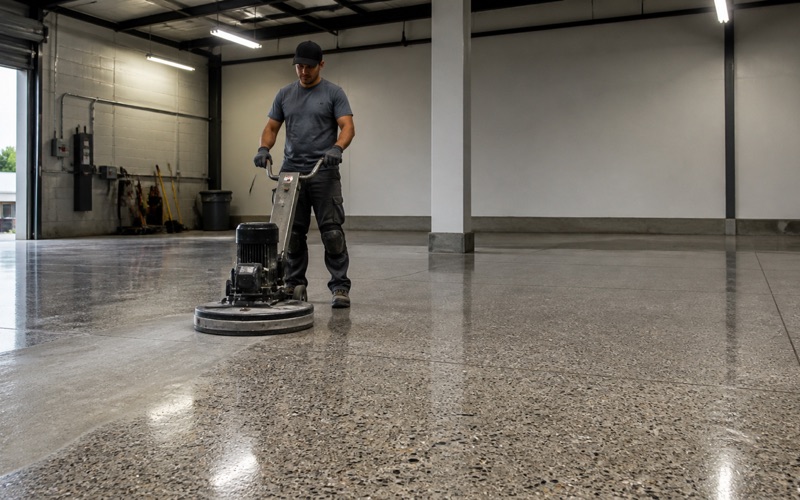
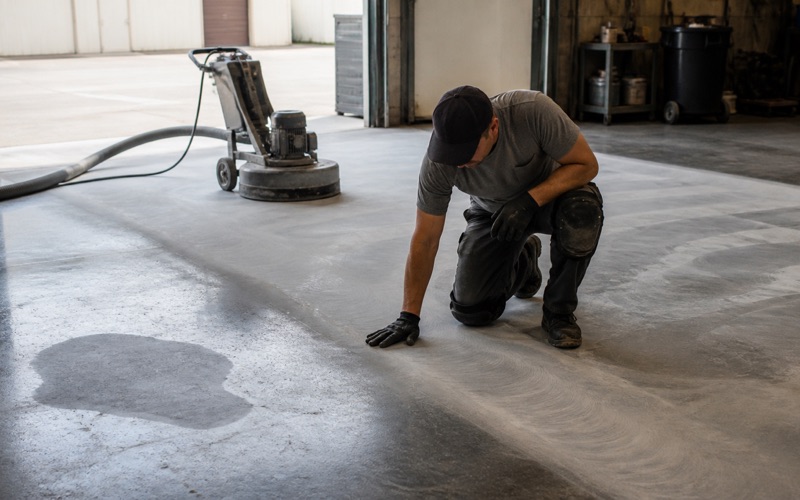
Whatever the ground turns out to be, the concrete gets opened up the same way: ground with diamonds or shot blasted to a profile we measure rather than eyeball, chosen against the floor’s size and how much access the building allows. Acid etching is not part of that, and neither is laying a system over a sealer somebody else applied.
That standard does not vary with the soil beneath, the age of the concrete or the part of town it sits in. Preparation remains the largest single predictor of whether a floor is still bonded in five years. What varies is the diagnosis that precedes it, and in a town with ground this mixed the diagnosis carries more weight than anywhere else we work.
- 20+ Years in the Brazos Valley
- Insured & Registered
- Free Written Proposals