College Station Epoxy Flooring installs epoxy flooring in Hempstead, and the first thing worth correcting is the assumption people carry into this part of Texas. A great deal of what gets said about clay in this region does not describe this town.
Hempstead is sandy. Only a fraction of a percent of the city carries reactive material near the top of the profile, and where reactive clay does exist it lies well below, generally somewhere between fourteen and twenty-three inches down. A third of the town is low-movement ground throughout.
The city is also unusual administratively. Its building inspector and fire marshal are a third-party firm rather than city staff, and its ordinance sets an explicit dollar floor on the liability insurance a contractor must carry.
Sand at the Surface and Clay Well Below It
What the Ground Actually Is
The dominant material here is sand, and one series covering a substantial share of the city is roughly five feet of it at around seven percent clay, sitting in the freest-draining hydrologic group there is. That is about as far from a movement problem as ground in this region gets.
Where reactive material does occur it sits well down the profile, buffered by a considerable depth of sand above it. Seasonal moisture change reaches it slowly and indirectly rather than acting on it from the weather directly.
Writing a movement-driven specification for a Hempstead slab would therefore be describing a problem the site does not have, and charging for engineering that achieves nothing. It would also crowd out the questions that genuinely matter on a slab here, which are about the concrete rather than the ground.
What Sand Means for a Slab
Free-draining ground is generally good news for a foundation, because water moves through rather than accumulating against the underside of the concrete. It removes the seasonal cycle that drives movement elsewhere in this region.
It does not remove every question. A slab on sand can still have been poured without an under-slab vapor retarder, can still carry moisture, and can still have a sealer or a previous coating on it. All three are found by testing rather than by assumption.
So the emphasis shifts from ground behavior to slab condition, which is a better set of problems because every one of them is within a contractor’s control. Weather acting on ground is not something anybody can specify around; a sealer on a slab is.
Testing Still Applies
On any slab we did not pour, moisture testing goes into the scope regardless of what the soil map suggests. Calcium chloride testing and in-situ relative humidity probes give figures that a product’s own thresholds are written against.
On easier ground those readings usually confirm what the map implied, and the resulting proposal is simpler and cheaper than one written for a difficult site. That is how it should work, and it is why the testing is worth doing rather than skipping.
Where a reading comes back higher than expected, the specification adjusts accordingly. The measurement describes the concrete in front of us rather than the ground it was poured on. That is the whole argument for testing rather than reasoning from a soil map on any individual property.
Looking for epoxy flooring closer to Prairie View? See Epoxy Flooring in Prairie View.
Who Inspects Work in Hempstead
A Third-Party Building Official
Hempstead’s building inspection and fire marshal functions are contracted to an outside firm rather than run by city employees. That is increasingly common in towns of this size and it is worth knowing before starting any permitted work.
Practically it changes how scheduling works. A third-party inspector operates to their own process and calendar rather than to a city department’s, and their availability rather than the city’s determines when an inspection happens.
For a straightforward interior floor coating none of this engages, since finish work of that kind is exempt from permitting. It matters where a floor forms part of a broader project. Knowing which of the two situations applies takes one question at the quoting stage.
What That Changes on Commercial Work
Where a floor is part of a commercial finish-out, the permit and inspection sequence has to be built into the program rather than assumed. Knowing that an outside firm controls that timing is genuinely useful when planning a shutdown. We ask what else is happening in a space rather than only what is happening to the floor, precisely so that this is established at the quoting stage rather than discovered mid-project.
Where the answer is that nothing else is happening, the job is simple and we say so. Manufacturing complexity that is not there does nobody any good. Most residential work in this town is genuinely straightforward and the quote should reflect that.
The County Question
The county surrounding Hempstead adopted its own fire code regime, which reaches commercial establishments, public buildings and larger residential buildings in unincorporated areas and includes an occupancy requirement.
Whether that regime reaches inside this city’s limits is not something we were able to establish, and we will not assert it in either direction. Where it matters to a specific project, it is a question for the city and the county rather than for a flooring contractor.
What we can say is that a coating-only job on an existing floor is finish work, and finish work of that kind does not carry a permit of its own wherever a code has been adopted. That much is consistent across every jurisdiction in this area and does not depend on the county question at all.
What the City Requires of a Contractor
An Insurance Floor Written Into the Ordinance
Hempstead’s ordinance sets specific minimum liability insurance figures for contractors, names the city as certificate holder, and requires notice before cancellation. Putting a dollar figure into an ordinance is more prescriptive than most towns of this size manage.
That is a genuinely useful thing for a property owner. It means the city has already decided what an acceptable level of cover looks like, and a contractor either meets it or does not.
We carry cover meeting that requirement, along with workers compensation and a Texas sales and use tax permit, and we are content for any of it to be checked. A certificate naming the city is easy to ask for and easy to verify, which is precisely why it is a useful requirement.
Why This Substitutes for Licensing
Texas issues no state license for flooring, coatings or painting work. That absence is genuine and it means a homeowner has very little to verify against when comparing contractors in this trade.
City-level requirements like this one partially fill the gap by defining a floor that can actually be checked. An insurance certificate naming the city is a document that either exists or does not, which is a considerably firmer thing than a claim.
We would rather point at that kind of verifiable requirement than describe ourselves in terms nobody can confirm. Anyone unwilling to produce that paperwork on request has told you something worth knowing.
What Goes Into the Proposal
Beyond credentials, the proposal itself is the main protection a customer has. Ours names the product, the system build and the mil thickness, along with what we found on the slab and both return-to-service dates.
That level of detail is awkward for a contractor to commit to, because it can be measured against the finished floor. That is exactly the reason to write it down rather than describe the work in general terms.
Where we think a coating is the wrong answer for a particular slab, the proposal says so instead. That has cost us jobs and it has never cost us a client. Turning down a job we do not believe in is cheaper than warranty work on a floor that should not have been sold.
A Small Owner-Occupied Market and What It Needs
A Predominantly Renting Town
Around sixty percent of households here rent rather than own, and the owner-occupied detached housing stock is small in absolute terms, numbering in the hundreds rather than the thousands. A significant share of owner households live in manufactured homes.
That shapes what the work looks like. There are fewer conventional attached garages here than the population alone would suggest, and a larger proportion of the concrete we are asked to coat is exterior or semi-exterior.
It also means rental and small commercial property makes up a bigger share of the local market than it would in a town of the same size with a higher ownership rate. That mix is worth understanding before assuming what kind of work a town this size generates.
Manufactured Homes and Exterior Slabs
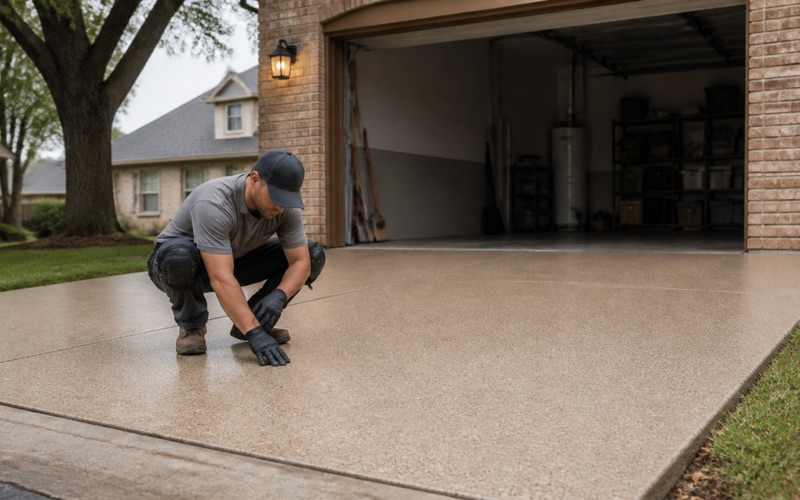
A manufactured home typically presents a pad, a carport slab or a patio rather than an enclosed garage, and those surfaces face direct sunlight, rain and thermal cycling.
That rules out an interior-grade epoxy topcoat and calls for an ultraviolet-stable polyaspartic or polyurea finish instead. Drainage matters as well, because a coating must not interfere with the fall that carries water away from a structure.
Using one system across interior and exterior concrete on the same property means either overspending inside or underspecifying outside, so we quote them as the different jobs they are. Coordinating color and texture across them still produces a consistent look without compromising either specification.
Rental Property and Turnover Work
Where a floor belongs to a rental property, durability and turnaround usually outrank appearance. A floor that survives several tenancies without attention is worth more to an owner than one that photographs well on the first day.
Fast-cure systems exist for genuinely tight handover windows and are the honest answer when the constraint is real rather than a way of charging more. We ask for the handover date before quoting because it can change the system entirely.
Older owner-occupied stock here skews substantially pre-1980, so on those properties the assessment matters more than the product choice does. What we find during the assessment on a pre-1980 slab changes the specification more often than the customer’s preference does.
- 20+ Years in the Brazos Valley
- Insured & Registered
- Free Written Proposals