College Station Epoxy Flooring installs epoxy flooring in Gause, a small unincorporated community where the most important thing to understand before hiring anybody has nothing to do with concrete. There is no city government here, and for a detached house there is no building permit authority at all.
That is not a gap in anyone’s research. The county appraisal district’s own roster of taxing entities names the county’s incorporated cities and does not include this community, while listing the local school district separately. There is no city hall to call and no municipal inspector to send.
For most work that changes nothing about how a floor is built. It changes a great deal about what a customer can rely on, because the usual backstop of a permit and an inspection simply is not there.
Who Has Authority Over a House Out Here
No City, and a County That Does Not Permit Houses
An unincorporated community has no municipal building department, and this county issues no building permit for a detached single-family house. Its permitting reaches commercial establishments, public buildings and multi-family residences through the fire marshal, and a house sits outside that scope entirely.
So on a private residence there is no plan review, no inspection and no certificate at the end. The work is governed by the contract and by whatever standards the contractor chooses to hold themselves to, and by nothing else.
People find that either reassuring or alarming depending on temperament, and both reactions are reasonable. What matters is knowing which situation you are in before signing anything rather than discovering it afterwards.
What Replaces an Inspection
Since no inspector will ever look at the floor, the substitutes have to be documentary and they have to be specific. Texas issues no state license for flooring, coatings or painting work at all, so a license number is not something any honest contractor in this trade can offer.
What can be offered and checked is general liability cover, workers compensation, a Texas sales and use tax permit, and a written proposal detailed enough to hold somebody to. We name the product, the system build and the mil thickness for that reason.
A specification that precise is awkward to write, because it can be measured against the finished floor. That is exactly why it is worth writing, and it matters more here than in a town where an inspector would have looked.
Commercial Work Is a Different Question
Where a building is commercial, public or multi-family, the county fire marshal’s regime does engage and permitting applies. That is a genuinely different process from residential work in the same community, and the two should not be assumed to match.
A coating-only job on an existing commercial floor is finish work and generally does not trigger anything on its own. Where it forms part of a wider finish-out, it rides on that project’s permit rather than standing alone. We check which situation applies rather than assuming, because getting it wrong in either direction wastes somebody’s time or creates a problem that surfaces late.
Looking for epoxy flooring closer to Brenham? See Epoxy Flooring in Brenham.
The School and What a Floor There Involves
The Only Institution Here
The local independent school district is the community’s only institution and effectively its only non-residential building of any scale. That makes it the one place in Gause where a genuinely commercial floor specification would apply.
Institutional floors are specified differently from residential ones because of what they face: concentrated foot traffic on defined routes, frequent cleaning with aggressive chemistry, and long stretches where the building cannot be disturbed at all.
That last constraint usually determines the system. Work has to fit into a break in the calendar, which means cure schedule matters as much as the finished surface does.
Cafeteria and Service Floors
Where a school prepares food, the requirements come from the Food Code that Texas adopts: a surface that is smooth, durable, easily cleanable and nonabsorbent where it gets wet, with a coved junction where the floor meets the wall.
The apparent conflict between a smooth floor and a slip-resistant one is resolved by the code itself, which explicitly permits antislip applications used for safety reasons. That carve-out is what allows a kitchen floor that is genuinely safe underfoot and still compliant.
Urethane cement is usually the right answer in a working kitchen because it tolerates heat, steam and washdown far better than a standard epoxy build. It costs more and it is the correct specification rather than an upgrade.
Scheduling Around a Calendar
A school floor is a summer job or a holiday job, and the handover date is fixed in a way most commercial deadlines are not. Where the window is genuinely tight, fast-cure systems exist for exactly that constraint.
We build the program backwards from the date the building reopens rather than forwards from when we could start. That is the only way a fixed-calendar job works reliably.
It also means the assessment has to happen well ahead of the work. Discovering a moisture problem the week before a summer shutdown is a considerably worse position than discovering it in March.
The Reactive Ground Is Not the Soil Named for This Place
A Name That Misleads
There is a soil series sharing this community’s name, and it is not the reactive material here. Its published extensibility is low, and a slab bearing on it is not the one with a movement problem.
The genuinely reactive ground in this area comes from a different component mapped in complex with it, and that component carries a substantially higher extensibility. The two appear together on the map under a combined name, which is where the confusion starts.
Anyone matching the place name to the series name and drawing a conclusion reaches the opposite of the truth. It is a small thing and it is exactly the sort of small thing that produces a confidently wrong specification.
What Is Actually Under a Slab Here
Most of this area is ground with a non-reactive layer at the surface and reactive material below it, along with a substantial share that is low-movement throughout. A minority carries reactive material close enough to the surface to matter directly.
Which of those a particular property sits on is a site question rather than a community-wide one. In a place this small the variation still exists, and the map does not resolve to individual lots.
So we look at the slab and take moisture readings rather than reasoning from the community name. The readings describe the concrete in front of us, which is the only thing the specification can safely be built on.
Why We Do Not Publish a Value Figure
Statistical estimates for a community this small carry very wide margins, and some of the published figures here have error ranges so large that quoting them would be misleading rather than informative.
We would rather say that plainly than repeat a number because it exists. A figure with an eighty percent margin of error is not a fact about this community, it is an artifact of sample size.
That principle applies to everything we put in a proposal. If we cannot stand behind a number, it does not go in the document.
Older Houses and What Is Under Them
Two Housing Eras and Little Between
The housing here divides sharply between properties built before the Second World War and a cohort built in the nineteen seventies, with relatively little in between and effectively no multi-unit stock at all. Nearly everything is detached and owner-occupied.
That profile means most slabs we work on here predate current practice around under-slab vapor retarders, and many predate a great deal else besides. An older slab is more likely to carry a previous coating, a sealer, or a repair somebody made decades ago.
None of that is a problem in itself. All of it is something to find before quoting rather than after starting, which is why an assessment visit matters more on older stock than on new.
What We Expect to Find
Sealers and curing compounds are the most common discovery and they are frequently invisible until water is dropped on the surface and beads rather than soaking in. A coating bonded to a sealer is only as good as that sealer’s own grip on the concrete.
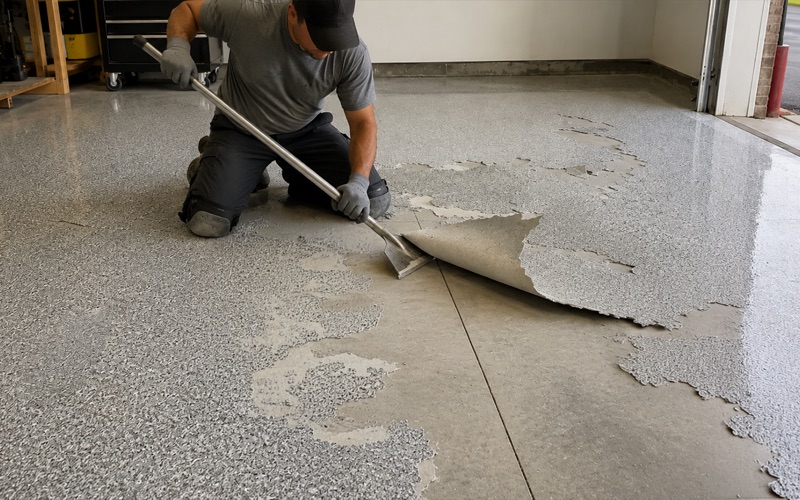
Old garage paint and store-bought kits also come off before anything else happens, using tooling ahead of the grinding pass. Removal is slower and dustier than preparing bare concrete, so it is quoted as its own line rather than absorbed into a rate.
Where a slab has been patched, the patch material matters as much as the concrete around it, because a coating has to bond to both and they do not always behave the same way.
Preparation Does Not Change With the Address
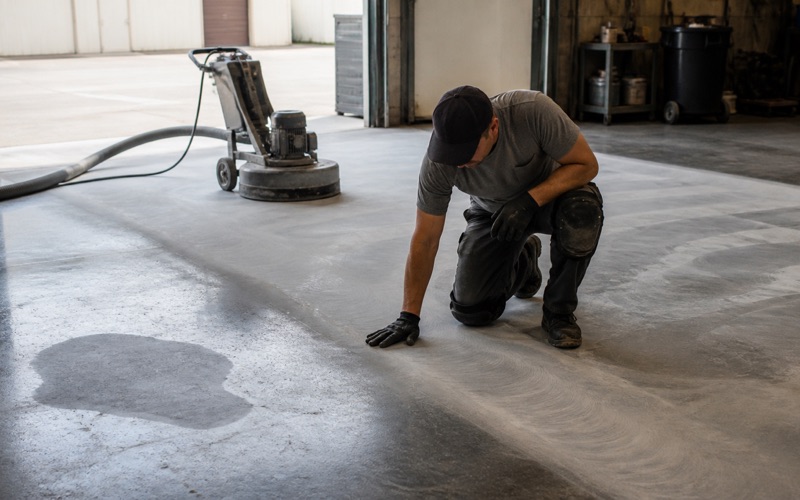
Every slab is opened mechanically to a measured surface profile, by diamond grinding or shot blasting depending on the floor and the access. We do not acid etch and we do not coat over an existing sealer, regardless of where the property sits.
What changes with an older rural property is usually access and logistics rather than standard. Power, water, working space and how far the nearest supplier sits all get planned before the day rather than solved on it.
The floor that results should be indistinguishable from one we would install in town. That is the point of having a standard rather than a set of local compromises.
- 20+ Years in the Brazos Valley
- Insured & Registered
- Free Written Proposals