College Station Epoxy Flooring installs epoxy flooring in Bryan on slabs that do not all behave the same way, which is the single most useful thing to know before buying a floor here. Bryan is not one ground. It is at least two, and which one your building sits on changes the specification. Two buildings of the same age and size, a few miles apart, can need genuinely different work under the same finish.
That is not a marketing distinction. It comes out of the soil mapping for the city, and the difference between the southwest side and everywhere else is large enough to change what we test for, what we treat, and what we tell you to expect from the finished floor. It also changes what we will put in writing about how the floor should behave over the years after we leave.
So the first thing we do is work out where your slab sits in that picture. It costs a site visit and it is the difference between a floor specified for your building and a floor specified for an average that does not exist. Every proposal we issue names what we found rather than what the county map says in general.
Why a Bryan Slab Depends on Which Side of Town It Is On
The City Splits Into Two Different Grounds
Taken as a whole, Bryan reads as a claypan city. Just under 5 percent of its area has reactive clay sitting at the surface, while a little over half has reactive clay lying under a non-reactive sandy cap. Those are two genuinely different engineering situations that happen to share a city limit. One is a surface problem you can see in a dry summer; the other is a subsurface problem that only shows itself through the slab.
Averaging them produces a specification that fits neither. A slab bearing on inert sand over deep clay has a different problem from one bearing directly on material that swells and shrinks with the seasons, and the honest answer is to find out which one you have rather than to split the difference. Splitting it is how a floor gets specified for conditions that are not present and left unprepared for the ones that are.
Quadrant by Quadrant
Split the city around its own centroid and the pattern is clear rather than subtle. The northeast is overwhelmingly reactive-below at 92 percent with almost nothing at the surface. The northwest runs 69 percent reactive-below with a substantial low-reactivity share. The southeast is more mixed, and a fifth of it has no published data at all. Those proportions come from the published soil mapping rather than from an impression formed on site.
The southwest is the outlier, and it is also the largest quadrant at 30 percent of the city. It carries 14 percent reactive ground at the surface, which is roughly five times what any other quadrant shows and is the only genuine surface tongue in Bryan. It is also the part of the city where a homeowner is most likely to have already seen seasonal movement in a driveway or a patio.
What That Means for a Quote
A quote given over the phone for a Bryan address is a quote given without the one variable that matters most. We look at the slab, establish which side of that divide it falls on, and take moisture readings before putting a number on the work. A visit costs us an hour and routinely changes the specification we would otherwise have written.
That also means two neighbors on opposite sides of town can receive materially different proposals for the same size garage, and both are correct. Explaining why is easier when the reasoning is written into the proposal rather than delivered as an opinion. Most people are entirely reasonable about a higher number once they can see what it is paying for.
Looking for epoxy flooring closer to Lake Bryan? See Epoxy Flooring Services in Lake Bryan.
Burleson Clay in the Southwest and What It Does to a Floor
A True Surface Vertisol
The southwest tongue is Burleson clay and Wilson loam, running toward the Brazos. Burleson is a Vertisol at roughly 50 percent clay, with a plasticity index of 41 to 44 and linear extensibility measured from the ground surface rather than from some depth below it.
That last detail is the whole point. Where reactive clay starts at the surface, seasonal moisture change acts directly on the material carrying the slab, rather than being buffered by a cap of inert sand above it. The slab is therefore responding to the weather in a way that a slab further north in the city largely is not.
What a Coating Can and Cannot Do About It
A coating is a film. It follows the slab it is bonded to, and no resinous system resists or bridges ground that is moving underneath it. Anyone offering a floor that solves a movement problem is describing something their own warranty will exclude. We would rather lose that comparison at the quoting stage than win it and be back in two years.
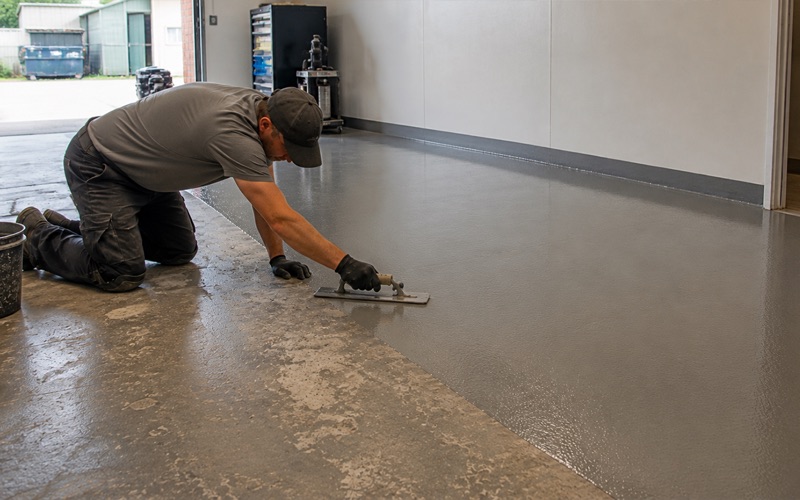
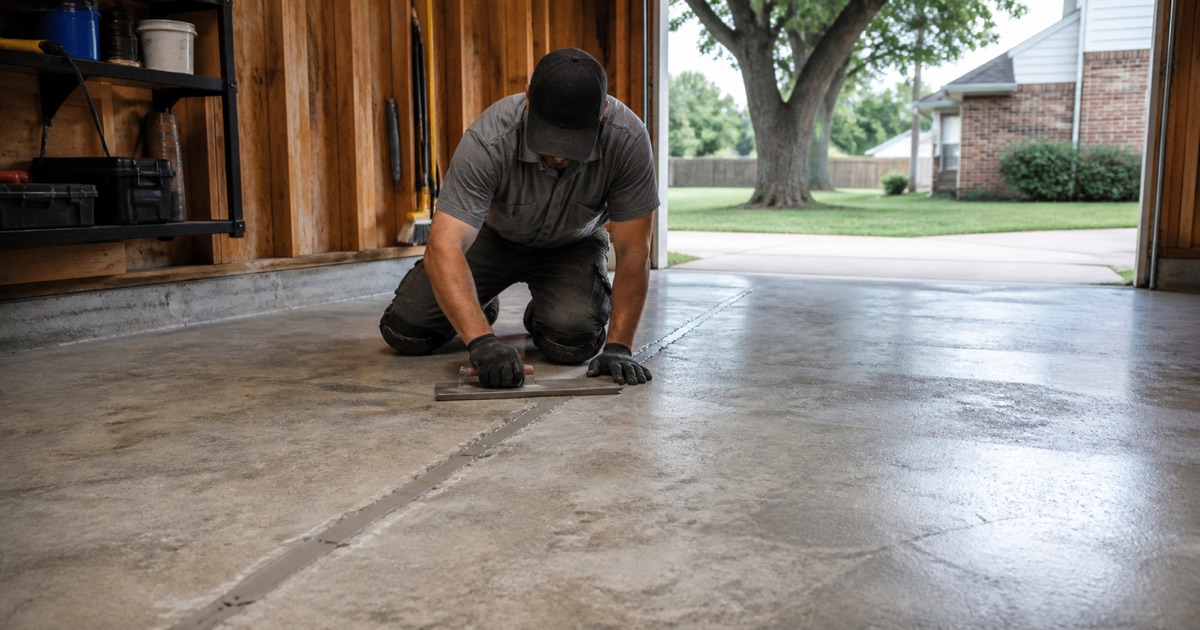
What we can do is treat the cracks honestly. A crack that has stopped moving is filled and disappears. A crack that is still working is treated as a joint with a semi-rigid polyurea filler that supports the edges while allowing movement, and we say before the job that it may telegraph again. Saying so in advance is the difference between a known limitation and a complaint.
The Mechanism on the Rest of the City
Where the reactive clay sits beneath a sandy cap, the cracking does not begin at the ground surface. The Crockett series description puts it plainly: cracks extend from the top of the clay horizon downward, and if the surface layer is eroded or thin, the soil cracks all the way to the surface. That single sentence explains most of the confusion between what a soil map predicts and what a builder actually encounters.
That last clause is the one that matters on a graded lot. Scraping a site before pouring removes the buffer, and a property whose soil map suggests a deep cap can behave like a surface Vertisol because the cap was taken away during construction. We ask about the site history for exactly this reason, because it frequently matters more than the map does.
The Quarter of This City With No Published Soil Data
Urban Land and Unnamed Map Units
Roughly a quarter of Bryan’s area carries no published shrink-swell data at all. Urban land accounts for about 17 percent of the city and unnamed map units another 6 percent, and neither category carries the horizon measurements the named series do. It covers much of the older core of the city, which is also where a large share of the garages we coat are located.
This is not a gap in our research. It is how soil surveys handle ground that has been built over, disturbed or filled, and it means the map genuinely stops having an answer across a substantial part of the older, more developed city. Recognizing that honestly is more useful than pretending the map is complete.
Why That Changes the Approach Rather Than the Price
Where the map has nothing to say, we test rather than infer. Moisture readings with calcium chloride and in-situ relative humidity probes tell us what the slab is doing now regardless of what the ground beneath it is called, and those numbers are what the specification is built on. The reading describes the slab in front of us rather than the ground it was poured on decades ago.
It also means we will not quote a soil-based story we cannot support for a property in those areas. Saying that the data stops is more useful than inventing a series name for a lot that has been graded, filled and built on twice. A confident soil story about an unmapped lot is a guess wearing technical vocabulary.
Testing Is the Answer to an Unmapped Lot
On any slab we did not pour, moisture testing is written into the scope rather than added afterward. A plastic sheet taped down overnight is a presence-or-absence check and nothing more; the quantitative tests are what a product’s own moisture thresholds are written against. The two tests answer different questions and we run both where the decision is close.
That matters on both sides of the city, but it matters most where the map is blank, because there the reading is the only real information available about what is happening under the floor. On those properties the test result is not a formality, it is the entire basis of the specification.
Older Bryan Slabs and What Is Under Them
An Older Owner-Occupied Stock
Bryan’s housing is meaningfully older than the newer development immediately south of it. Just over half of the city’s owner-occupied units predate 1980, a higher share than the stock as a whole, and the median year built across all housing sits in the early 1990s. That gap is one of the few genuine differences between the two halves of this metro from a flooring perspective.
For a coatings contractor that age profile is the most practical fact about the city. An older slab is more likely to have been poured before under-slab vapor retarders were standard practice, more likely to carry a previous coating or a sealer, and more likely to have been repaired at some point. None of that is a problem in itself, but all of it is something to find before quoting rather than after starting.
What We Find on an Older Slab
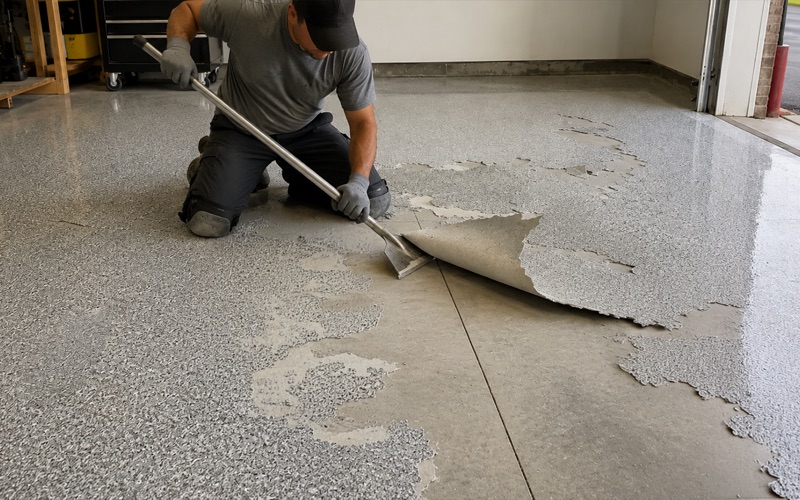
Sealers and curing compounds are the usual discovery, and they are frequently invisible until water is dropped on the surface and beads instead of soaking in. A coating bonded to a sealer is only as good as that sealer’s grip, which nobody has measured. It is also the failure that looks perfect on handover day and lets go in sheets a year later.
Old adhesive, previous garage paint and store-bought kits also come off before anything goes down. Removal is slower and dustier than preparing bare concrete, so it is quoted as its own line rather than discovered halfway through a job and renegotiated. Knowing what is on a floor before pricing its removal is worth the twenty minutes it takes to establish.
Preparation Does Not Change With the Address
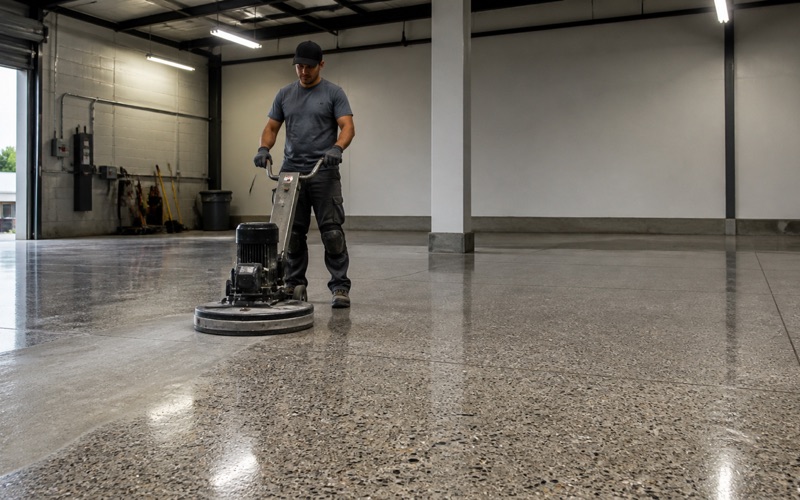
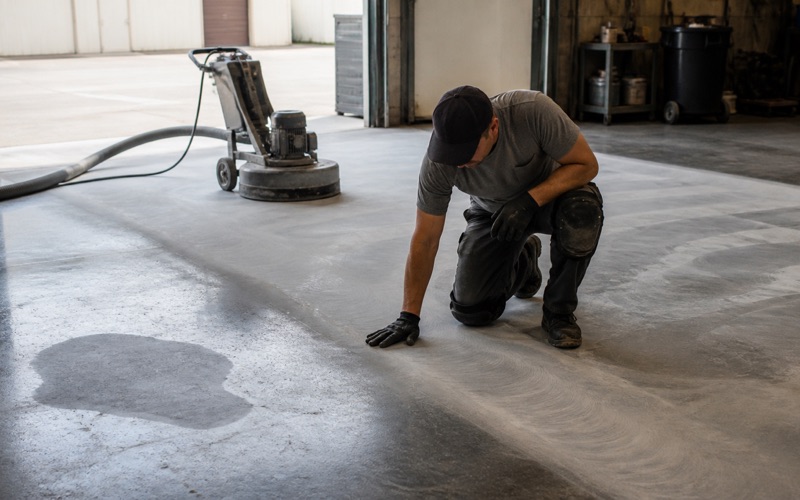
Every slab is opened mechanically to a measured surface profile, by diamond grinding or shot blasting depending on the floor. We do not acid etch and we do not coat over an existing sealer, on either side of the city. The profile is checked against the comparators rather than judged by eye, because the bond depends on it.
What changes with the address is what we expect to find and what we test for. The preparation standard is the same in the southwest as in the northeast; the diagnosis that precedes it is not, and that is the part worth paying attention to when comparing quotes. If two proposals for the same Bryan garage differ substantially, the diagnosis behind them is usually where the difference actually lies.
- 20+ Years in the Brazos Valley
- Insured & Registered
- Free Written Proposals