College Station Epoxy Flooring installs epoxy flooring in Brenham, and this town needs a different conversation from most of the area we cover. Across much of the Brazos Valley the first question about a slab is moisture. In Brenham it is movement, and that reversal changes almost everything downstream of it.
The ground here is genuinely shrink-swell country. More than a quarter of the city sits on soils that are reactive right at the surface, and the series carrying that ground are well drained rather than holding water seasonally. There is no perched water table doing damage from below; there is clay opening and closing with the weather.
The unusual thing is that the city itself publishes evidence of it. Brenham runs a dedicated permit class for foundation repair, and the numbers it issues year after year say more about local ground than any soil map summary could.
Movement Rather Than Moisture in Brenham
Well Drained Ground That Still Moves
The reactive soils here are well or moderately well drained, which means they do not hold a seasonal wet zone against the underside of a slab. That removes the moisture-vapor problem that dominates elsewhere in this region and leaves a cleaner, harder problem in its place.
Clay that drains freely still swells when it takes up water and shrinks when it dries. The movement is driven by moisture change rather than by standing moisture, and a slab bearing on it responds to the weather over a season rather than to a water table underneath it.
That distinction matters because the two problems have different answers. A moisture problem is solved with testing and a mitigation primer. A movement problem is not solved by a coating at all, and pretending otherwise is the most common dishonesty in this trade.
Why the Distinction Changes the Specification
Where movement leads, joint and crack strategy becomes the center of the specification rather than an afterthought. Which cracks are still working, how they are filled, and what the customer is told to expect all matter more than the choice between one resin system and another.
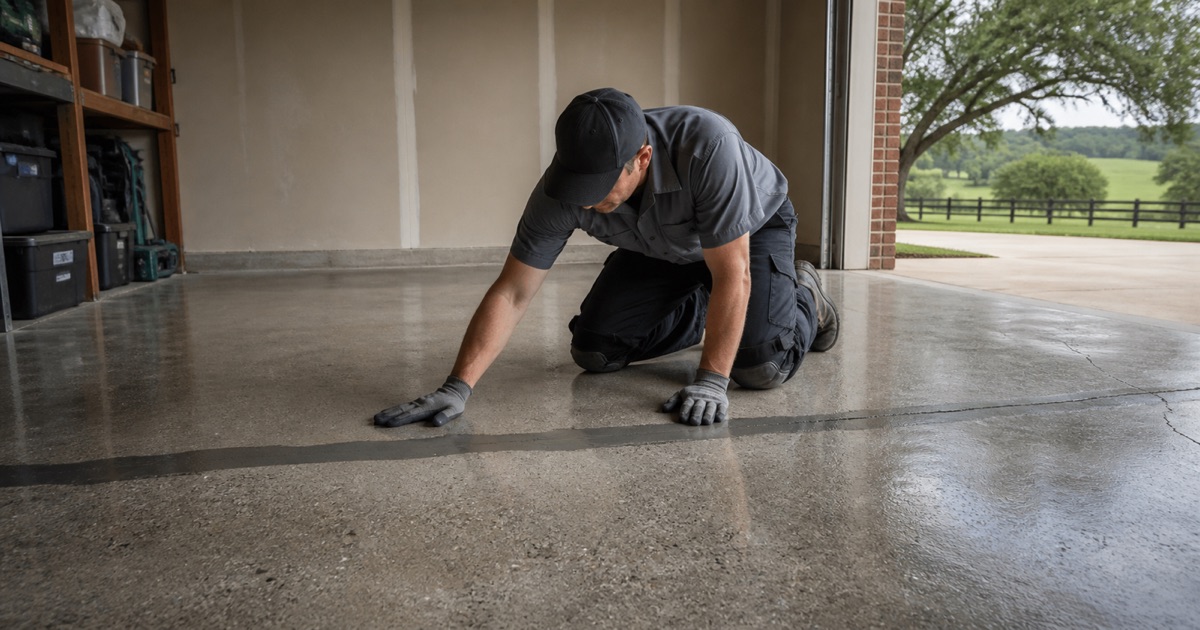
We spend proportionally more of the assessment here on reading the existing slab. Crack patterns, previous repairs, door and frame adjustments and any history of foundation work all say something about what the ground has already done to this particular building.
That reading then drives the quote. Two Brenham garages of the same size can carry quite different proposals, and the difference is almost always in how much joint and crack work the slab actually needs.
What a Coating Will Not Do
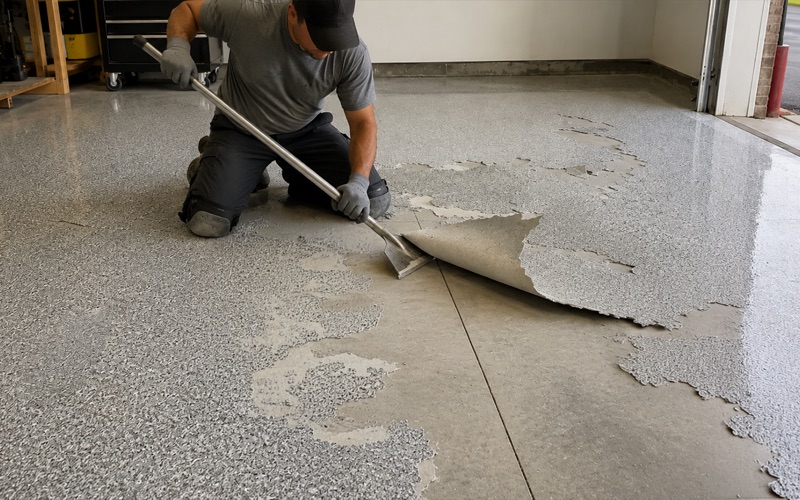
A resinous floor is a film bonded to concrete. It follows the slab exactly, and no system at any price bridges, absorbs or resists ground movement underneath it. Any quote implying otherwise is describing something its own warranty will exclude.
What a good specification does deliver is a floor that handles movement gracefully. Live cracks treated as joints, semi-rigid fillers that support both edges, and honest advance warning that a working crack may telegraph through the finish again.
Saying that before the job rather than after a crack appears is the difference between a known limitation and a complaint. On ground like this it is the single most important thing a contractor can be straight about.
Looking for epoxy flooring closer to Madisonville? See Epoxy Flooring Services in Madisonville.
What the City’s Own Foundation Permits Show
A Dedicated Permit Class
Brenham operates specific residential and commercial foundation repair permit categories, which most cities of this size do not bother to separate out. Having a category at all implies enough recurring work to justify tracking it.
The counts bear that out. The city issued twenty-seven foundation repair permits in 2024, eighteen in 2025, and fifteen across the first seven months of 2026, a steady rather than occasional stream of work on a town of this population.
Those are public numbers, and they are considerably more persuasive than a soil classification. They describe what is actually happening to buildings here rather than what the ground is theoretically capable of doing.
What That Means for a Floor Buyer
It means an honest contractor will raise foundation questions before selling you a floor, and that raising them is not a sales tactic. A coating over a slab with an unresolved movement problem is money spent in the wrong order.
Where a slab has already been repaired, that is genuinely useful information rather than a red flag. A stabilized slab with documented work behind it is frequently a better candidate for a good floor than an untouched one whose history nobody knows.
We ask about it directly at the assessment. Owners are usually happy to talk about it, and the answer often changes what we recommend more than anything visible on the surface does.
Reading the Existing Floor
Cracks that follow a consistent line, hairline maps across a bay, and previous patching all tell a story about which way a slab has moved and whether it is still moving. That reading is free and it is more informative than any test we could run.
Where the pattern suggests ongoing movement, we say so and treat the affected cracks as joints rather than filling them solid. Where it suggests a slab that settled years ago and stopped, the work is considerably simpler and the quote reflects that.
Neither answer is bad news in itself. What would be bad is coating over the evidence and finding out afterwards which of the two situations the building was in.
Cracks That Stay Open for Months
What the Series Descriptions Say
The three soil series carrying Brenham’s surface-reactive ground all state that their cracks remain open for ninety to one hundred and fifty cumulative days in most years. That is a published characteristic of the material rather than an estimate.
Read plainly, it describes ground that is open for a third to nearly half of a typical year. Water enters rapidly while the cracks are open and very slowly once they close, which drives a cycle that repeats annually and indefinitely.
That is a fundamentally different situation from a construction-era defect that can be fixed once. It is a permanent property of the site, and a building on it is in an ongoing relationship with the weather.
Spread Across the Whole Town
The measured reactive share here runs across every quadrant of the city rather than concentrating in one area, so on the published mapping location within town tells you less than it does in several nearby towns. That is a statement about how the soil survey falls rather than a rule about any individual property.
What does vary is the specific series under a given property and the slope it sits on, both of which affect how much movement the ground actually delivers. That is a site-level question rather than a neighborhood-level one.
So we assess the property rather than the postcode. In a town where the ground is broadly similar everywhere, the differences that matter are found by visiting rather than by looking at a map.
How We Build a Floor Over It
Joint treatment carries more of the specification here than the resin choice does. Semi-rigid polyurea fillers support crack and joint edges under load while permitting the movement that is going to happen regardless of what we would prefer.
Preparation is unchanged: every slab is opened mechanically to a measured profile, by grinding or shot blasting, and we do not acid etch or coat over an existing sealer. That standard does not move with the soil type.
What moves is the expectation we set. A floor here is specified to cope with a moving substrate, and the proposal says so in writing rather than leaving it to be discovered.
What Needs a Permit Here and What Does Not
Flooring Is Named Explicitly
Brenham’s own list of work not requiring a permit names flooring outright, alongside painting, wallpapering, carpeting, cabinets and countertops. That is more explicit than most cities manage, which usually leave it to the general finish-work exemption.
It is also honestly bounded. Foundations, garage enclosures and driveways are all permit-required in the same document, so the exemption covers finish work rather than anything structural or anything outside the building envelope. Knowing exactly where that line sits is useful, because it means a straightforward garage floor coating is unambiguously exempt while a project that touches the slab itself is not.
Contractor Registration Applies Broadly
The city requires contractor registration together with a liability certificate naming the city, and it applies to subcontractors as well as general contractors, on residential work as well as commercial. That is a wider net than most towns cast.
We hold that registration and carry the certificate. Since Texas issues no state license for flooring, coatings or painting work, a city registration and an insurance certificate are among the few credentials in this trade that can actually be verified. That is worth asking any contractor for, here more than most places, precisely because the city has already decided it matters enough to require.
The Inspection Regime Behind It
Brenham runs its own building department with city staff rather than contracting inspection out, and it employs its own environmental health inspector for food premises. Plan review and inspection scheduling both run on published timeframes.
For commercial work that changes the planning rather than the floor. Where a floor forms part of a wider finish-out, the permit and inspection sequence has to be built into the program rather than treated as an afterthought. For a residential garage floor it changes nothing at all, which is worth saying plainly so nobody assumes a permit process that does not apply to their job.
- 20+ Years in the Brazos Valley
- Insured & Registered
- Free Written Proposals