College Station Epoxy Flooring installs epoxy flooring in Bellville, a small county seat with a genuinely complicated piece of ground underneath it. Three separate land resource areas meet inside this one city, which is unusual for a town of any size and remarkable for one this small.
That convergence is the single most useful fact about working here. It means a soil answer that fits one part of town can be wrong a short distance away, and it means the general character of the surrounding county is a poor guide to any particular property.
Around a tenth of the city carries material that swells and shrinks near the top of the profile, a further third has it lying beneath a cap, and rather more than a third does not move at all. All three are present within the same city limits. Few towns of this size present that much variety, and it is the reason a site visit here is worth more than anywhere else we work.
Three Different Soil Regions in One Town
What Convergence Means on the Ground
Land resource areas are broad regions defined by geology, soils and climate acting together, and a town normally sits comfortably inside one. Bellville does not. It sits where three meet, and the boundaries run through the town rather than around it.
The consequence is real variety over short distances. Ground that swells seasonally, ground with the same material buffered beneath an inert cap, and ground that is stable throughout all occur inside the same small city.
So the honest answer to what is under a Bellville slab is that it depends where the slab is, and that answer requires a visit rather than a map lookup. We would rather say that than offer a confident generalization that turns out to describe the next street over.
The Reactive Share and What Carries It
Two series between them carry most of the movement-prone ground here, and both publish descriptions stating that their cracks stay open for a substantial part of a typical year. One of them notes that its properties appear to overlap those of a well-known heavy clay series.
That is a meaningful statement about material behavior rather than a technicality. Ground of that character opens as it dries and closes as it wets, on an annual cycle that repeats indefinitely. It is a permanent property of the site rather than a construction-era defect that can be fixed once.
Where a slab sits on it, the slab moves with it, and a coating bonded to that slab moves too. That is the situation the specification has to be honest about. A coating follows the slab it is bonded to and no system at any price resists what the ground beneath is doing.
Numbers Belong to Their Own Survey Area
One caution worth stating, because it is a real trap in published soil data. The same series can carry different measured values depending on which county survey area is being quoted, and the figures are not interchangeable.
Quoting a value recorded in a neighboring county for a property here would be citing a real number about the wrong place. Both figures are correct for their own area and neither is correct for both.
So we quote what belongs to this county when discussing this town, and we do not blend or average across survey areas. It is a small discipline that keeps a technical claim honest. It also means a figure quoted at you should come with the county it belongs to attached.
Looking for epoxy flooring closer to Pinehurst? See Pinehurst Epoxy Flooring.
What the County Requires Before Anything Is Built
A Real Development Permit Regime
The county operates a development permit process run out of the county seat, which requires a permit before anything is moved onto or constructed on a property, charges doubled fees where work starts early, and includes a final inspection.
That is more structure than many rural Texas counties provide, and it is worth knowing about for anything beyond an interior floor. A county that inspects is a county whose paperwork matters. Anything touching a slab, a structure or a new build is worth checking against that process early.
For a floor coating inside an existing building, none of it engages. Finish work of that kind sits outside permitting wherever a code has been adopted. Saying so plainly is more useful than implying a process that does not apply to a garage floor.
No Contractor Registration in the City
The city itself does not require a contractor to register in order to pull a building permit, which is a lighter touch than several neighboring towns take. That is a genuine difference rather than an oversight.
It does mean a property owner here has one fewer external check available when comparing contractors. Where a city maintains a register, that list does some of the verification work; where it does not, the owner has to do it directly. That is entirely doable and it takes one request for documentation.
Since Texas issues no state license for flooring, coatings or painting work at all, the practical substitutes are liability cover, workers compensation and a Texas sales and use tax permit, all of which can be asked for and confirmed. Anybody unwilling to produce them on request has told you something worth knowing.
What a Proposal Has to Carry
Where there is less external verification available, the written proposal does more of the work. Ours names the product, the system build and the mil thickness, along with what we found on the slab and both return-to-service dates.
That specificity is deliberately awkward, because it lets the finished floor be measured against what was sold. A quote that describes the work in general terms cannot be checked at all. The awkwardness is the point rather than a side effect. Where we think a coating is the wrong answer for a particular slab, the proposal says that instead of quoting the work anyway.
A Detached, Owner-Heavy Housing Stock
Almost Entirely Houses
More than three quarters of the housing here is detached, there are effectively no duplex units in the town at all, and the ownership rate is high. Vacancy is very low by any standard. That produces a market dominated by owner-occupied houses with conventional attached garages, which is close to the opposite of several towns in this service area.
Practically it means most enquiries here are homeowners planning a floor for themselves rather than landlords preparing a unit for handover, and the priorities differ accordingly. A floor somebody intends to keep is specified differently from one being prepared for handover.
What Owners Ask For
An owner-occupier is generally buying a floor they intend to live with for years, which shifts the balance toward appearance and toward finishes that continue to look good rather than simply surviving.
That does not reduce the importance of preparation. It usually increases it, because a floor somebody looks at daily shows a poor bond or a telegraphed crack far more visibly than a rental garage does.
We spend proportionally more of the conversation here on finish selection, sample panels and texture underfoot, because those are the decisions an owner will live with. Sample panels cost very little and settle most of those decisions before any material is ordered.
The Bimodal Build Era
The housing stock splits oddly. More than half predates 1980 and around a fifth predates 1950, while a meaningful share has been built since 2010, with comparatively little in the middle decades. That means two quite different slabs turn up regularly: genuinely old concrete poured long before under-slab vapor retarders were standard, and recent slabs built to current practice.
The assessment differs sharply between them. On the older stock we expect sealers, previous coatings and repairs; on the newer, curing compounds and a slab that may still be releasing moisture from the pour. Both are handled the same way, by testing first and grinding to a measured profile second.
Old Houses and New Ones, and Little in Between
Working on Pre-War Concrete
A slab poured before the Second World War is a different proposition entirely. It may have no vapor retarder beneath it, an unknown mix, and decades of accumulated coatings, sealers and repairs on its surface.
Moisture testing matters most on exactly this stock, because there may be nothing under the slab to interrupt vapor rising from the ground. Calcium chloride testing and in-situ relative humidity probes give figures a product’s thresholds are written against. Where the readings call for a moisture-mitigation primer it appears in the proposal rather than arriving as a change order once the grinder is already running.
Removing What Is Already There
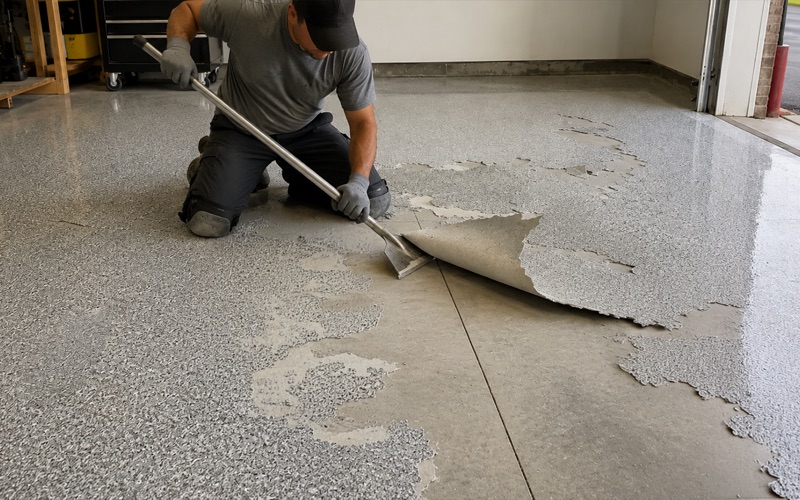
Old garage paint, store-bought kits, adhesive from a removed covering and previous coatings all come off before anything else happens, using tooling ahead of the grinding pass.
That work is slower and dustier than preparing bare concrete, so it is quoted as its own line rather than folded into a square-foot rate. Knowing what is on a floor before pricing its removal is worth the time it takes to establish.
Patches matter too, since a coating has to bond to the repair material as well as to the original slab, and the two do not always accept the same primer. Finding that out during the assessment is considerably better than finding it out after priming.
The Same Standard Either Way
Every slab is opened mechanically to a measured surface profile, by diamond grinding or shot blasting depending on the floor and the access. We do not acid etch and we do not coat over an existing sealer.
That standard does not change with the age of the concrete or the part of town it sits in. What changes is what we expect to find and therefore what we test for. On ground as varied as this town’s, that diagnostic step carries more weight than anywhere else in this service area.
- 20+ Years in the Brazos Valley
- Insured & Registered
- Free Written Proposals